The artist
An interview with Polly Borland
Standfirst!!!!!!
lorem ipsum dolor sit amet consectetur adipiscing elit in excepteur quo maxime illum id pariatur assumenda ut iusto fugiat exercitation est et et minus cupiditate pariatur placeat do id sunt anim molestias quis fugiat veniam est veniam nulla in nobis ut nulla ut dolore est labore corrupti distinctio cumque corrupti commodo dolore nulla non accusamus et animi in
Your practice is centred on the human form—sculpting around a real person. Can you speak a little bit about the inspiration behind that method?
I'd been a portrait photographer, and for me that had become very limiting creatively. I needed more to do, and the 2D space really was not stimulating me. I started experimenting with the tapestries, with the lenticulars and then I started doing costumes. The method came out of me creating these costumes, and I think the costumes came from the Adult Baby work I'd done.
Whenever I feel limited or if I get bored, then I need to push past the materials I'm using, or the portrait.
As someone who has established a reputation in photography, what has the process been like for you, pivoting towards something new? Have there been unexpected challenges working in sculpture?
lt's quicker doing photography, but it was sort of a natural development. When you look at all the series of photographs I've done outside of the traditional portraiture work, one series leads to another, leads to another, leads to another. And then, you know, the sculpture was almost inevitable.
It wasn't difficult. The difficult part is you have to wait. I'm dependent on other people. This [medium] means I've got to have someone, as I'm making the sculpture around a person with stockings and stuffing. I also have to have someone there that's going to document it with a 3D scanner.
BOD is a focal part of the exhibition, sharing a space with If I Die, Please Delete My SoundCloud. How has placing the sculptures within the context of loneliness impacted your view of them?
How does it feel to have your work shown alongside local artists in a gallery that prioritises experimentation and depth of engagement?


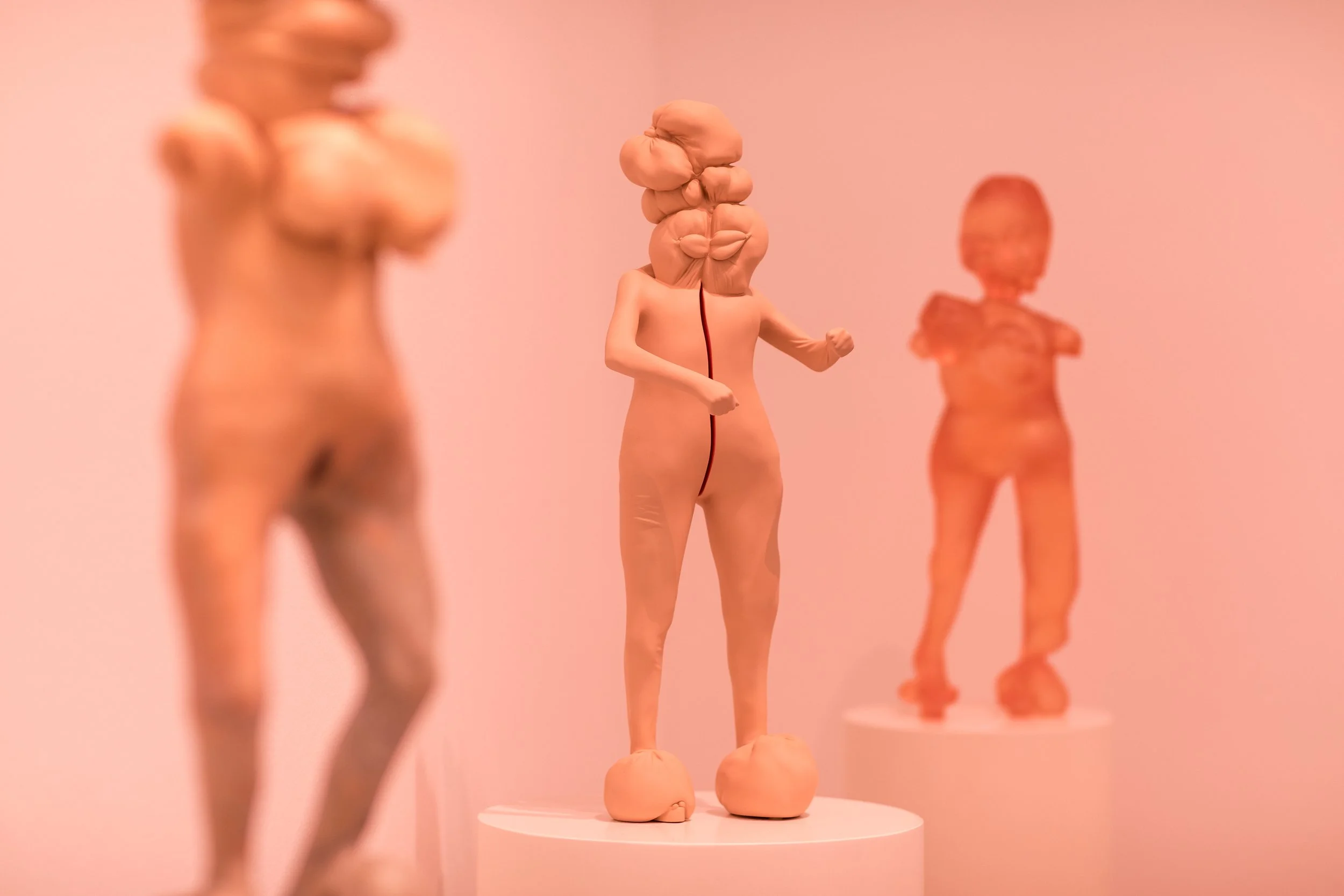
All my work’s sort of about the body, but it's also about existence and what it means to be human, and what it means to be inside one's body. There's a sort of a loneliness to this figure that is not human, but you can sort of see remnants of the human form in the sculpture, behind the veil of the fabric and the stuffing.
BOD wasn’t made with loneliness in mind, but it is very isolating, the experience of the model, because they are kind of sensorily deprived. They don’t have any sight, their hearing is muffled—they've got to be pretty still once we get them in the pose, and they’re cocooned by this stuffing and stocking fabric.
I think the loneliness is that they’re lone figures. People are inside them, though you can't necessarily tell that there's someone in there in the final sculpture. They're very isolated in there.
I loved that, and I love Miles and Sophie. I hadn't shown at ACCA before, I hadn't even been in the building until I met Miles so yeah, it feels great.
And obviously it wasn't only Australian people, there were quite a few international people and a lot of them were young. I liked that about it because I like to be surrounded by young people. I like the energy of young people, and I like the fact that younger people can be unfiltered about what's right and wrong. Whereas I think a lot of people of my generation have been brought up with a lot of, you know, in the shadow of the Second World War, and there's a lot of baggage. And really, we're the baby boomers who kind of screwed it up for everybody else. I like how young people just seem to know what’s what.
How does it feel to have your work shown alongside local artists in a gallery that prioritises experimentation and depth of engagement?
I think each artist had a different perspective; Patrick Pound's work [Museum of Loneliness 2026] was interestingly kind of about memory. A lot of those things in there spoke literally about loneliness, but there was a nostalgia to it and a kind of, I think memory, because each person's memory is very unique. So that spoke to memory, or nostalgia, but also loneliness.
And then there was the tapestry [Lonely Planet 2026] which I thought was brilliant. And again, it was about technology but she [Kayla Mattes] makes things by hand and it’s kind of the opposite of technology, as well as she was using the sort of aesthetic of like the early, you know, Pac-Man.
And then the other thing that I loved was by Callum McGrath [What’s after this? 2026].
The exhibition definitely had different points of view; each artist brought their own angle.
Image credits: Left to right: Polly Borland, Froggy 2025, Slit 2025, Toothy 2025, installation view, Australian Centre for Contemporary Art, Naarm/Melbourne, 2026. Courtesy the artist and MECCA Collection. Naarm/Melbourne. Photograph: Andrew Curtis.