
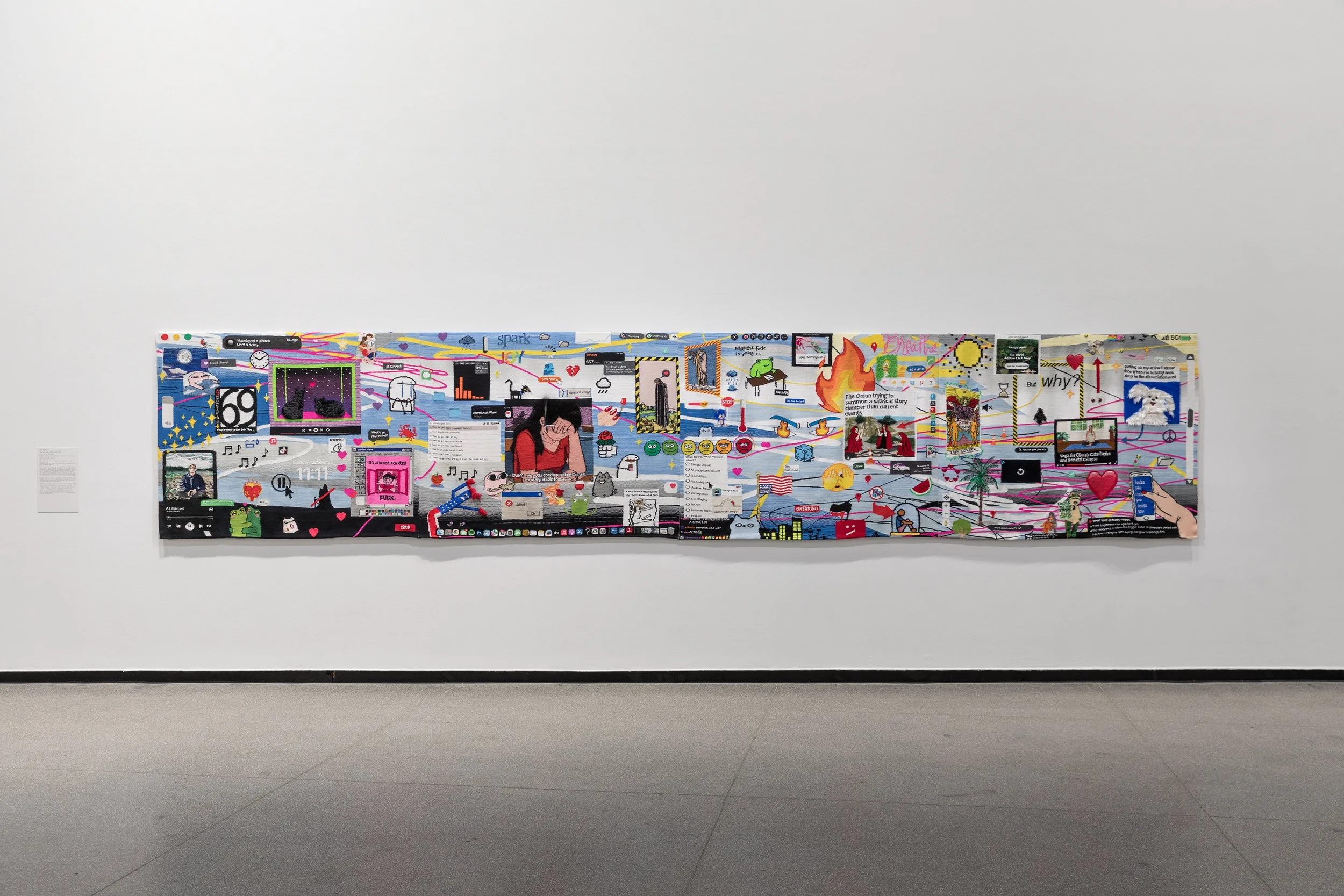


Kayla Mattes, Lonely Planet 2026, installation view. Commissioned by Australian Centre for Contemporary Art, Naarm/Melbourne. Courtesy the artist. Supported in part by a Foundation for Contemporary Arts Emergency Grant. Photograph: Andrew Curtis
Lonely Planet
Niamh Mills
Lonely Planet is a soft, tactile look at internet culture and the human condition. Examining Kayla Mattes’s tapestry depicting various internet memes, digital iconography and romantic imagery, I first notice the textile nature of the work: colourful wool and thread arranged meticulously into pictures within pictures that overwhelm my senses. It is hard to appraise the work as a whole. This seems to be intentional—the enormity of the internet cannot be appraised in one sitting, either. The piece feels simultaneously cluttered and empty, its elements isolated from each other on a sea of greys and blues interspersed with streams of bold colour. It is both strange and familiar, cold and warm. As I look at it, I feel an overwhelming sense of exhaustion at the scale of what it represents. A computer screen is a window to connection with the rest of humanity and yet it is so small and limited.
There are few feelings quite as lonely as sitting in your room in the middle of the night on your laptop and looking up from your computer screen in the dark and realising that, though you have this bright little window of information and community, you are
completely alone. Your chest aches with something you cannot describe; not quite sadness but close to it, not quite exhaustion but something beside it. You are almost numb, yet welling with a quiet, inexpressible energy that it would be useless to explore. The space between you and the rest of the world is vast and hollow. You turn back to the screen and resume your trawl through its contents.
Lonely Planet itself is that screen; the borders feature the user interface typical of a MacBook. I myself despise the rare occasions I am required to use Apple laptops. The keyboards lack substance. The keys require light, sleek taps instead of heavy, tactile crunches; the mousepad is rigid and vibrates unpleasantly once clicked. It has always been a poor sensory experience for me. Lonely Planet is much the same in parts. Its pictures are spread apart from each other and left cold and alone in the sea of grey.
My own experience with internet culture echoes this sea. The friends I have made and am yet so far from meeting, the stories and memes and songs given to me by faceless strangers as I scroll through the endless feeds of social media platforms. Ideas rush past
like leaves in a river, getting caught on a stray branch and sticking there for a while where we can see them, before the current tears them away again and they are lost. They distract you, they excite you, but they don’t stay for long.
Lonely Planet’s composition of Internet memes reflects this sentiment; the stark grey of the backdrop may be spotted by these pops of colour, but they cannot cover the underlying monotony completely. Its plush, woven medium evokes comfort and nostalgia, bringing a warm texture and third dimension to its iconography. Yet the uniformity of the background and the spaces between each image become an impassable divide. The images themselves all represent loneliness, isolation, a yearning for connection, or some form of hardship as seen through the lens of the internet—album covers for lonely ballads, existential memes asking questions that seek no answer, step counters showing their user’s lack of physical activity. All of these speak of a deep need for human connection that can only be partially fulfilled by online interaction.
Darker, more topical imagery pervades the piece as well: a snippet of a chat log
discussing protests and police brutality, symbols in support of Palestine and in opposition to
ICE, a survey asking the viewer what current threat causes them the most anxiety. Just like that anxiety, these details can be quickly lost in the fog of endless content. But they remain ever present in the background, even as you try to distract yourself with entertainment and connection, frantically clawing your way free of the heavy burden of critical thinking and the guilt that you are safe and they are not.
As an example of an internet trend within the piece, we have the viral sensation
Punch the monkey. Punch, a baby Japanese macaque who had been abandoned by his mother and rejected by the troop of macaques he was placed in within Ueno Zoo, found solace in the company of a stuffed orangutan toy. Videos of the baby monkey clinging to his plush surrogate family were posted online, where they quickly amassed enormous amounts of popularity and sympathy the world over. Almost everybody who saw the videos felt a deep sadness and kinship with the little creature and Mattes has immortalised him and his beloved companion in her work to represent this outpouring of emotion. I think many people saw his loneliness and recognised themselves in him; helpless, dependent, isolated. They wanted him to connect with his kind, but even more so, perhaps subconsciously, they wanted to connect with other humans as well.
They knew the pain of rejection and wished it would be removed from the lives of both
Punch and themselves. Everyone is alone in their own right, trapped inside their heads, but Mattes takes the knowledge of this universal loneliness and subverts it; the concept of a ‘lonely planet’ is an oxymoron, in a sense. Yes, the celestial body itself could be considered lonely, but its population of over eight billion humans and countless other animals, who all rely on each other in some capacity, could never be truly alone.
Other symbols featured in the work have more obscure meanings, such as the tarot cards Mattes has incorporated: the ‘Lovers’, the ‘Hermit’ and the ‘Five of Cups’. Tarot, a traditional method of divination, has existed in some form since around the fifteenth century and yet it is still widely used today, becoming popularised in part by the rise of social media platforms such as Instagram and TikTok. The first two cards have their titles displayed. They carry seemingly straightforward meanings, representing the work’s consistent themes of isolation and interpersonal relationships, but the lonely, black-shrouded figure in the Five of Cups bears no title of their own. According to traditional interpretations of tarot cards, the Five of Cups generally represents grief, loss, disappointment and stagnation. More than that, it is a lack of motivation to move on, a willingness to wallow in hardship despite the possibility of hope.
The cloaked figure stands still, head bowed low towards the five cups scattered lamely around their feet. Three cups are lying on their sides before the figure, their contents
pooling on the ground, but two cups persist, standing upright behind the figure, whose sorrow renders them unable to turn and realise what they still have left. I don’t think I know a single other person who finds it easy to turn around. I rarely find the strength to turn
around myself. However, Mattes has made a small change to the Five of Cups: a small black thought bubble containing a pink love heart, something often used as a reaction to a text message. Perhaps this represents that someone loves the figure on the card despite their refusal to seize their agency, or perhaps whoever has sent the heart does not care enough to compose a text to the figure, opting instead for a quick and wordless response. Conversely, it could be from the mind of the figure themself, accepting or even admiring their situation for what it is.
Mattes’s crowded, maximalist visual style persists through her body of work; her tapestries are cluttered with bold colour and Easter eggs, rarely allowing the eye to rest save for the occasional dark spot, forcing the viewer to drink in every detail one by one, to hunt for something yet unseen. In the development of Lonely Planet, Mattes created a digital collage to plan the final design. By the artist’s own admission, the piece took a great deal of consideration, with every element carefully chosen to represent its themes and evoke the desired emotion within the viewer. In the act of composing this collage solely from imagery familiar to its target audience, Mattes has put a greater focus on creating a sensory and emotional nostalgia rather than encouraging a personal interpretation. The images and symbols shown all have explicit associations and meanings in the contexts they originate from. It’s likely the implied viewer will know what a certain image means and understand its intended message instantaneously, rather than spending time trying to create their own reading of it. It is only by looking at the whole piece and its collective emotionality that we can ascertain Mattes’s intentions with her artwork.
From the choices made in Lonely Planet, I feel that Kayla Mattes has a deep and profound understanding of internet culture and what parts of it pull on the heartstrings of its users. Mattes knows what we find harrowingly relatable, what we know to be pathetic within ourselves and what makes us feel seen in a place where we are shrunk down to short clips and still images.
Tapestry may be Lonely Planet’s medium, but at the same time it works too well as a metaphor; the intricacy and artistry behind not only the physical skill needed to create the piece, but the intellectual and emotional labour put into it, qualifies as a tapestry on its own. A piece with such a capability to evoke emotion is a rare find, especially in such an obscure and difficult medium. In this unique age, where technology is affecting human communication in extreme and unprecedented ways, we need unique works of art to help us reflect on and contextualise our relationship to digital culture. Mattes has opened a window to the isolated self in the global community through Lonely planet. The internet connects us in a remarkably detached way, where we are permitted to worry about faraway things and faraway strangers but never to speak directly to them, never to see them without a screen. Mattes knows this, using it masterfully to take the viewer on a trawl through the endless ocean of the web.
With a strong grasp of sentiment and fine detail, Mattes’s work is a treat for the eyes and a bittersweet lance through the heart. It draws your curiosity and carves a hole in your chest; it makes you realise both the fundamental interconnectedness and isolation we share as a species in today’s world. Lonely planet’s simplistic beauty and haunting relatability make it worth sitting and spending time with. Perhaps it will inspire connection outside of technology in its viewers, or perhaps it will reinforce their dependency on it. I hope that anyone who finds it as deeply meaningful as I have takes comfort from it, rather than a feeling of desolation.
Niamh Mills (any pronouns) is a creative writing student at RMIT. They are an avid player of Dungeons & Dragons and have an interest in online cultures and spaces, something they explore through ‘Lonely Planet’