


The grotesque
Scout Daniels
The Conception
What is a Body? A shape or an ideal? Flesh covering fat,
covering muscle, covering bone? A figure in the distance?`
Standing here like this? Naked, alone?
✶✶✶
It could not be deemed a loud conception, one of grandeur or prophecy. It burrowed deep into your flesh, without your knowledge, as you slept that lonesome night.
It found the weak spot—fresh tissue near your neck—and it submerged its hooked fangs into a tendon covering your throat.
It slithered into your veins, your blood, your chemistry.
All was still, no inkling of change, but the skin around your bicep began to stretch, slowly engorging your forearm, followed by your hands.
Your fingernails were next to go, a habit of biting them suddenly at bay, nothing left to gnaw on.
Your voice came out quiet; something was holding you back. Your tongue barely reaching the back of your teeth, jaw clenching uncontrollably. You couldn’t speak after that, didn’t dare try.
You slept, naked, unable to control the sweat that would secrete through every pore. It seeped into the mattress that sat in the corner of your room, leaving an off-white stain in the shape of your body’s imprint that became larger every night.
One morning you woke, unable to move. Like a beetle on its back, you wriggled and wiggled, tossing your limbs in a sea of white cotton.
One by one, your arms and legs began to lock into place. One arm tossed over your face and your feet, they swelled with angst. A rush of numbness ran rampant through every vein, every nerve, every cell.
You could no longer see; your arm fused to your cheeks as this thing stewed and gurgled within your limbs. You could no longer sleep. What made you so attractive to it? What made you weak? Vulnerable?
Every bulge was a release, a suppression bared. You daydreamed of a set of hands smoothing and moulding them one by one. Hands attached to a body you could no longer see, no longer interact with.
And yet, you could not desire to interact with anyone. You were urged by a feeling masked as a craving to be alone in this room as you lethargically transformed.
But your wishes were not granted. The doors opened and all you heard was the squeaks and clattering of shoes; the sighs, the slight gusts of wind you felt on your bare skin as people passed by.
At least you could not see their faces. Their brows furrowed, wondering what happened to you, what you had done to deserve this, something they could then avoid.
You are a warning sign; plastered on prescription boxes, before gambling ads, around crime scenes.
The Interaction
‘The grotesque body … is a body in the act of becoming. It is never finished, never completed; it is continually built, created, and builds and creates another body. More-over, the body swallows the world and is itself swallowed by the world … It outgrows its own self, transgressing its own body … ’
– Mikhail Bakhtin¹
✶✶✶
The pink hue of the room cascaded out into the others. I noticed you before I could see you. You stood there, facing away from me, tall, your back drooping. I noticed your ear, before it began to engulf your face.
What is this thing that holds you? Is it a thing? Is it a part of you? Does it have a name? Are you its host? Without you, would it simply cease to exist? Do you hold it in your arms at night, swaying to an old country song?
I wonder if I would feel more comfortable if you were clothed?
Your body billows and bulges, creases and bends. You serve this being, it tightens its grip around your chest. You let it.
~
There were two entrances to the exhibition. Borland’s BOD leaked from the far room. I made a conscious decision to avoid it. I walked through the space, the bright strokes of colour, curations of objects, blending into the speckled cement floor. When I reached that last room, I wasn’t stirred with emotion. I felt nothing. Looking back, I know it was an attempt to avoid the feeling that was evoked, one that I habitually suppress. It wasn’t until the second visit that I spent more time walking around the work. I traced each crevice with my eyes, looking for a beginning and an end. I was shocked to find out that the material was aluminium. How could something that looks so soft and plush be made from metal?
The psychological becomes a physical and becomes a psychological once more; the cycle could go on and on. BOD is not a work that needs language. One feels it in the space. It radiates heat throughout the open room. My eyes could not help but trace the billowing surface, even if it was with distaste.
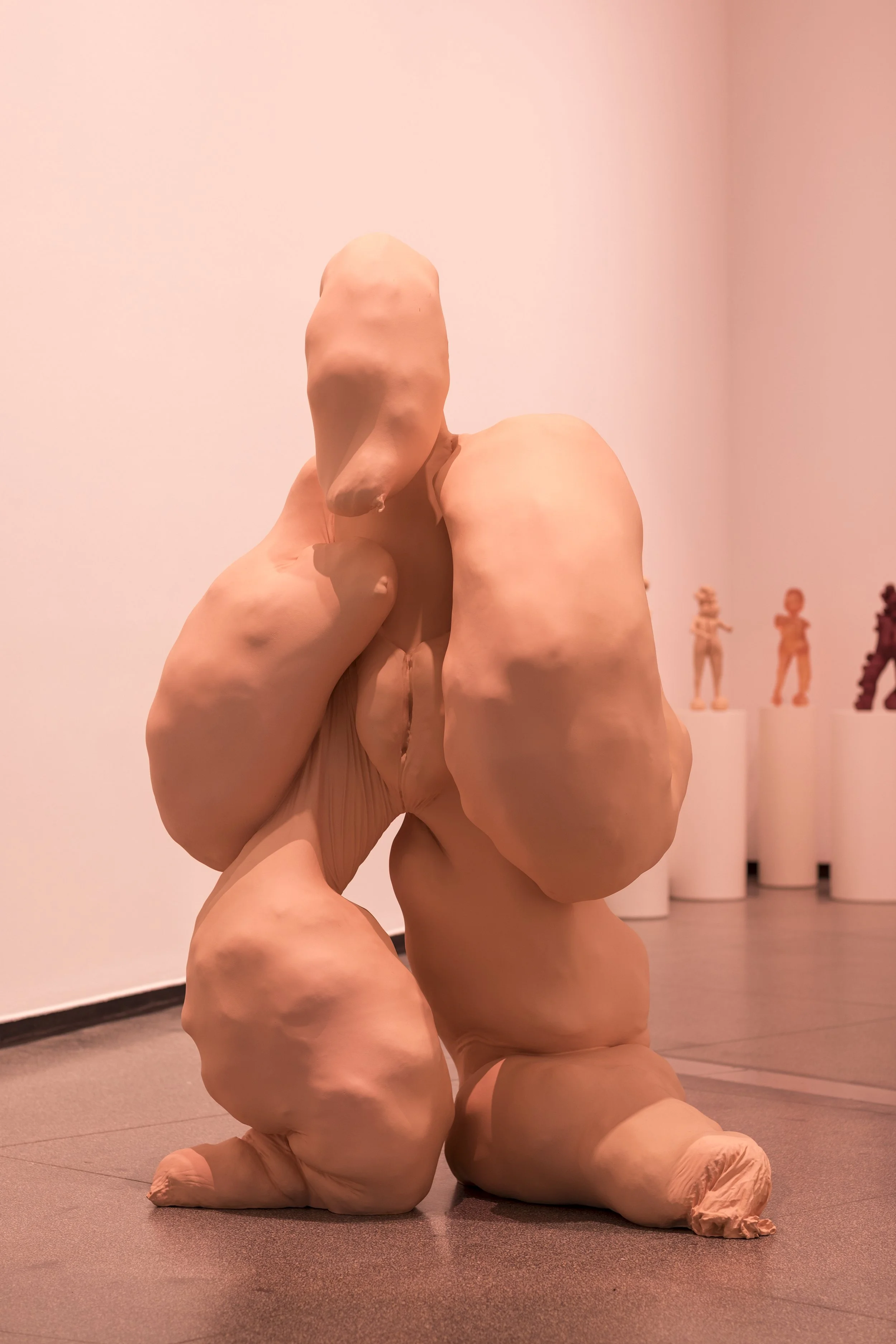
BOD does not stand alone in the space; its smaller BLOB siblings are displayed in the corner, differing in textures and scale. At 7 feet tall, BOD is understood in its own relational site, fixed between colossal and realistic proportions. Comparisons with human forms are inevitable, but it also extends and removes what we may expect to see: hair, freckles, pores, discolouration, veins, stretch marks. Even when Borland strips these sculptures down to a raw abstract human form, BOD remains a relational object that aids in the question of what makes us human.
What separates BOD from its siblings relates to what it can exhibit. Every crease is accentuated when blown to a larger scale. It becomes much like a spectacle positioned towards the middle of the room. Unlike the BLOBS, we can stand next to this ‘creature’ and not feel unrealistically small in comparison.
Borland’s previous works, such as her initial project, MORPH², are a collection of images that are brought to life through the play of costume on human canvases. Bod, as described by Borland, is positioned as ‘pre-consciousness, pre-human, pre-thought’³, the human model is encased inside, ‘wrapped in this cocoon-like state’⁴. From these still images comes a sculpture; what was once a vision, soft and plush, has been replaced by a solidified exterior, removing and recontextualising the human underneath. It is yet another opportunity, much like a photograph, to capture a moment of transformation.
BOD is explicitly gendered. The notable yonic display front and center gathers and folds to reveal a vulnerable display of sexuality, in a nonsexual manner.
✶✶✶
What I couldn’t shake when I stood next to BOD was an urge to diagnose. Like a physician writing a report, I needed a name for it, a way to understand. I am conditioned to understand the body, my body, as something that needs to be problematised.
I look at BOD and see a version of myself sitting on a hospital bed, completely isolated. I was in that room for twelve days. I remember the still air at night when visitors were sent home, the only sounds remaining were beeps and alarms. On New Year’s Eve, a nurse had decided to check my vitals as the clock struck twelve. I wished her a happy new year as she wrapped the cuff around my arm; she just smiled. The Sydney fireworks were on the television; colours of red, yellow and blue flooded the dim room. I remember feeling everything and nothing all at the same time. I knew that this wasn’t my fault, that I had not put myself in this position, but I had this horrible feeling that I was going to feel like this forever. A few days later I was sent home, with the pyjama pants I had worn to the emergency room and a strip of Panadol.
I remember seeing the large scar down my back for the first time. It had settled by then, the stitches dissolved. It healed with an indent. Even now, I squirm if I accidentally touch it. The sensation feels ‘other’. Like this skin is not my own, not completely attached.
To me, BOD is a personification of that time in my life, filled with dread, lumps and humps.
Borland has revealed that she personally ‘never felt ease in [her] own body’,4 alluding to these projects offering a cathartic quality. Art can be an act of doing that words can never encompass. An exploration of one’s own psyche can only begin with the uncomfortable. For many, including myself, the subject of the ‘body’ remains tender, following us through many stages of life.
At first glance, I could barely look. But when I left the exhibition, I felt something.
The Metamorphosis - 31st of August 2026
At last,
We stayed in one place long enough… (Fossora)
To shoot down deep hyphae roots… (Fossora)
That penetrate concrete and plastic…(Fossora)
Even though the ground is burnt… (Fossora)
Underneath monumental growth… (Fossora)
– Björk, Atopos, Fossora
✶✶✶
As I left you in that room, warm only by light, I wondered what your final form was destined to be.
When the lights turn off and the doors close, do you slump into a heap on the floor like the wicked witch’s cloak? Or do you crawl to that bed in the corner like a small child, craving the touch only a mother holds? Wrapping yourself in the covers, singing yourself a lullaby to rest?
You could leave this room, find a way out. Yet you stay.
You like it here, don’t you? A teasing act has become routine. Those faces you once hated that morph from disgust into sympathy have become what you crave. This isn’t the real you, they don’t know that, but you do. You assure yourself every morning, as they mop the floors around you, but are you sure this is still true.
This thing inside of you is not what it seems.
The day may come when you become two. A split of self, a change of ownership. It will not stick around. They say that once it has what it wants, it leaves you high and dry.
The only remains are the pit in your stomach, the ache of your bones, skin you cannot strip and scrub clean.
But is this truly what you want? Will what once craved you and fed on your flesh now be your deepest desire? Will you miss the feeling of it pressed against you, wrapped in a warm embrace?
Maybe you just need a change of scenery. I know a place, where the world around you collectively breathes in and out. The air feels cleaner and yes, it may take some getting used to, but I think you’ll like it here.
From a distance, you may still look like a pack of bubblegum, chewed up and spat out. That’s what they did to you, left you like this, put you on display.
This place will make you feel different.
Here, you are a web of spores. The earth can suck you up whole, let the roots shoot out from your swollen toes, and split, and then split again. Come on, sink your feet into the ground.
I imagine you standing in this dirt, the pink of your flesh now muddy, muted, but you’re free. Who cares that your feet are dirty?
Björk created a word, ‘fossora’, a feminised version of the Latin word ‘fossore’ meaning ‘digger’ or ‘delver’. She says that it means ‘she who digs’⁵, urging us to stop and let the roots grow. In a world so obsessed with moving, look at how beautiful you can be if you just stand still.
Here you don’t need to hide, to retreat. Go on, dig. Dig deeper.
I know you don’t want to live like this forever.
References
¹ Bakhtin M & Iswolsky H (1984) Rabelais and His World, Indiana University Press.
² https://wildingcran.com/artists/84-polly-borland/series/morph/
³,⁴ https://nga.gov.au/on-demand/artists-in-conversation-polly-borland-and-claire-lambe/
Scout Daniels is an emerging writer who lives and studies creative writing on Wurundjeri Country. She primarily writes creative non-fiction, and she is fascinated by memory and the body, which she explores in this piece. Scout enjoys scrapbooking and crocheting alongside her broader creative writing practice.
Image credit:
Polly Borland, BOD 2023, installation view, Australian Centre for Contemporary Art, Naarm/Melbourne,2026.Courtesy the artist and Sullivan+Strumpf. Photograph: Andrew Curtis