INDUSTRY

What is the current state of literary fiction published by Australian small presses?
Madeleine Dunn, Rimini FitzGerald & Riley Orange
Australian literary fiction is known as a genre in decline. This is worsened by the consolidation of multinational publishing, reduced arts funding and increased market-driven publishing practices, with major publishers progressively withdrawing from literary fiction in favour of safer, commercially predictable genres. Yet, despite repeated claims of decline, literary fiction in Australia has not disappeared. Instead, it has undergone a transformation in both its modes of production and cultural identity. The genre is sustained through independent publishers, small presses, specialised booksellers, literary awards and engaged readerships that continue to value literary fiction for its cultural significance.
The literary fiction situation
Literary fiction is inherently difficult to define, and is often characterised by its refusal for categorisation, favouring uniqueness instead. Literary fiction has migrated away from large commercial publishers towards small presses and independent cultural institutions. These small presses continue to play a crucial role in publishing experimental, politically challenging and culturally significant work that may otherwise be considered commercially risky. Many of these publishers also participate within global circuits of translation, prize culture and international literary exchange.
Australian literary fiction is more tied to traditional ideas of national culture. Giramondo’s emphasis on translated literature through their Southern Latitudes series (a listing devoted to promoting books from the southern hemisphere), the popularity of translated and backlisted fiction at The Paperback Bookshop and Amplify Bookstore’s focus on BIPOC authors collectively suggest that literary fiction in Australia increasingly exists within broader transnational and postcolonial frameworks. Rather than functioning solely as a distinctly national literary tradition, Australian literary fiction now appears embedded within a global literary marketplace shaped by translation, international awards, digital circulation and cross-cultural exchange.
The economic conditions surrounding literary fiction remain precarious. Small presses frequently operate with limited resources, reduced institutional support and uncertain long-term sustainability. Independent publishers are often required to balance cultural prestige with financial viability, relying on literary awards, grants, niche readerships and strong editorial identities to maintain relevance within an increasingly corporatised publishing industry. Nevertheless, the continued success of independent publishers and the sustained readership found within independent bookshops suggests that literary fiction retains considerable cultural value despite it being commercially risky.
A genre in decline
While literary fiction is often described as a genre ‘perpetually in decline’, publication has shifted, instead being dominated by small presses. This transition has reshaped the identity of literary fiction in Australia as a genre increasingly sustained through cultural value and symbolic capital by a concentrated ‘prosumptive’ audience.
Globalisation, deregulation, corporate consolidation and the rise of data-driven publishing practices transformed the publishing industry, resulting in contemporary literary fiction being ‘abandoned’ by major publishers in favour of commercially predictable genres. Federal funding for the arts continues to be cut, ‘at just under 3%, literature receives the smallest piece of this pie’—a figure that has more than halved over the past two decades. These structural and economic conditions shape the current ecosystem of literary fiction publishing.
The marketing of books has been impacted since the structural changes in the newspaper industry, reducing the visibility and perceived cultural significance of literary fiction. The emergence of BookScan intensified publishers’ focus on commercially profitable titles. As large publishers scaled back their production of literary fiction, small publishers were in a unique position to respond to the gap in the market that ‘conglomerates are unable [and unwilling] to occupy.’
The pushback from small publishers
Despite limited commercial value, literary fiction has an enduring cultural value and symbolic capital. Drawing from Bourdieu’s theory of cultural production, literary fiction demonstrates ‘the possibility of non-market cultures and values that undercut ideological assumptions about how free-market societies function.’ Literary fiction remains practised and consumed which stands as a testament to the ongoing value attached to it. Many award-winning Australian authors such as Alexis Wright, Gerald Murnane and Miriam Campbell are published almost exclusively by independent presses, which suggests that these publishers sustain cultural and symbolic value beyond commercial value.
Small publishers are often more willing to take risks to publish exciting, innovative or stylistically or politically important work, which then offers authors more creative freedom. Historically, literary movements and books written by great writers have not been published by giant companies. In this regard, literary fiction’s return to independent publishers enables creative possibilities that might otherwise have been constrained by commercial pressures at large publishers.
Small publishers almost exclusively mediate literary fiction, its audience has become increasingly ‘prosumptive’—they are involved in the production or mediation of literature or publishing. Alongside the rapid growth of the Emerging Writers Festival and the rise of enrolments in university creative writing courses and programs, these are indicators of an enduring interest in literature, despite declining mass-market success.
Established in 1995, Giramondo continues publishing literary fiction and poetry despite the commercial decline of these genres within mainstream Australian publishing. Giramondo appears to operate through a model based on cultural prestige and long-term investment in writers.
Giramondo’s Fiction, Poetry, and Southern Latitude catalogues
Their catalogue demonstrates clear trends in output across genres over time. Fiction and poetry have remained consistent in core categories since the press’ inception, while Southern Latitudes emerged later as a significant transnational series focused on writing from the global south.
During Giramondo’s earlier years, publication numbers were relatively modest, often limited to a small number of poetry and fiction titles annually. By the late 2010s and early 2020s, Giramondo was regularly publishing multiple fiction and poetry titles each year, suggesting a period of institutional stability and expansion. The Poetry catalogue demonstrates sustained output across nearly three decades. Authors such as Judith Beveridge, Andy Jackson and Eunice Andrada appear repeatedly across the catalogue, which indicates that Giramondo maintains long-term relationships with writers rather than publishing isolated titles.
Approximate catalogue totals from the available website records suggest there is a visible expansion in Giramondo’s literary output over time. The catalogue reveals that poetry remains central to the press. While many commercial Australian publishers have reduced poetry publication significantly due to limited profitability, Giramondo continues releasing multiple poetry collections annually. The press values literary and cultural contribution over immediate commercial viability. Another thing of note is the increasing presence of translated and international literature, particularly through the Southern Latitudes series. Southern Latitudes includes writers from Indonesia, Argentina, New Zealand and other regions of the southern hemisphere, many translated into English for Australian publication. International titles such as Happy Stories, Mostly by Norman Erikson Pasaribu and Imminence by Mariana Dimópulos suggest that Giramondo actively positions Australian literary culture within broader global and postcolonial networks. Giramondo’s catalogue suggests that contemporary literary fiction in Australia increasingly operates through transnational exchange and translation.
Giramondo’s relationship with Alexis Wright
Alexis Wright, author of Carpentaria (2006) and Praiseworthy (2024), and her relationship with Giramondo provides a useful example because her work demonstrates the kind of literary writing that small presses may sustain despite limited commercial certainty. Giramondo published Carpentaria in 2006 after the manuscript had reportedly been rejected by larger publishers. The novel later won the Miles Franklin Literary Award and became one of the most critically significant Australian novels of the twenty-first century. Giramondo subsequently continued publishing Wright’s later works, including The Swan Book and Praiseworthy.
Giramondo’s publishing model depends partly on sustained editorial investment in writers whose cultural significance may emerge gradually rather than immediately through sales. Wright’s fiction is formally experimental, politically challenging and often very long, thereby making it difficult to market through mainstream commercial publishing. Giramondo’s willingness to continue supporting such work suggests a publishing philosophy centred on literary value rather than profitability.
There seems to be several contributing factors to Giramondo’s longevity: consistent literary branding, long-term author relationships and a catalogue that combines Australian literary fiction with translated and international writing. Together, it suggests that Giramondo reflects broader conditions within the Australian literary landscape in which literary fiction is increasingly sustained through small-scale cultural institutions that prioritise long-term literary value, transnational exchange and editorial investment over immediate commercial success. The press’ consistent publication of poetry, experimental fiction and translated literature, alongside its ongoing support of writers such as Alexis Wright, indicates that Australian literary fiction continues to survive through niche but culturally influential publishing networks that shape literary identity beyond mainstream market demands.
The Paperback Bookshop
The Paperback Bookshop is an independent bookshop established in the mid-1960s. The Paperback’s 2025 bestseller list suggests readers are still buying and reading literary fiction, since literary fiction titles made up 70% of their 2025 bestseller list.
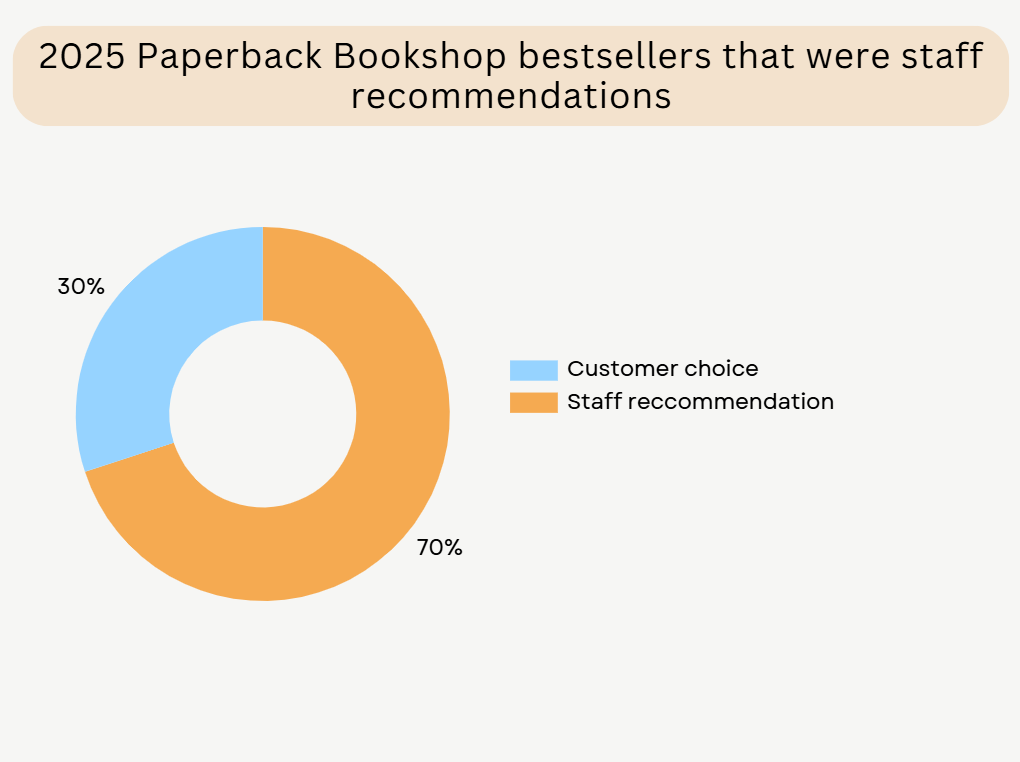
In the 2016 Australia Council for the Arts and Macquarie University survey, 71% of Australians bought books from physical bookstores, with the most common ways readers discovered books were through ‘word of mouth’ (66%) and ‘physical bookstores’ (53%). This influence is evident in the Paperback’s bestseller list, where staff recommendations accounted for 70% of bestselling titles. As Anna MacDonald—owner of the Paperback Bookstore—explains, ‘Readers want personal recommendations.’
Giramondo Publishing
The growing interest in backlisted fiction
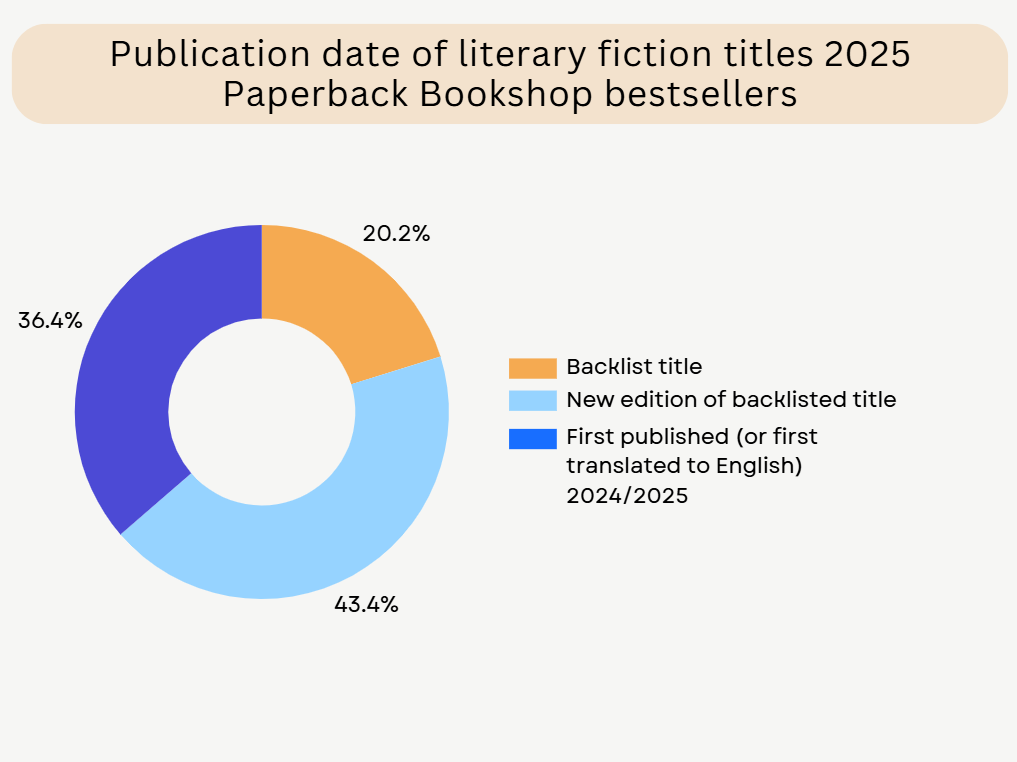
Only 36% of literary fiction bestsellers on the list were first published or translated into English between 2024–2025. The remaining titles were either new editions of backlisted works (43%) or older backlist titles (20%) (figure 3). Among translated works, half were originally published between 1940–2000.
This resurgence can partly be linked to social media, as was particularly the case with I Who Have Never Known Men (1995), Madonna in a Fur Coat (1943) and The Wall (1963) that went viral on social media and have since seen a commercial resurgence. Increasingly, Australian readers (an estimated 37%) discover books through social media platforms.
When asked about the demographic of readers of literary fiction the concept of ‘prosumption’, MacDonald described the Paperback’s readership as ‘extremely diverse … all ages and identities, from all walks of life.’ She rejected the perception of literary fiction as ‘highbrow’, describing it as an ‘unnecessary antagonism … to be rejected and fought against.’ In response to why she reads literary fiction, MacDonald replied: ‘I read—anything—because I’m curious about the world and my place in it. Because I feel a connection to the people I read about, and the people who write about them. Because I love ideas and new perspectives.’ It is evident from the bestseller list that customers share a similar sentiment to MacDonald.
The power of translated works
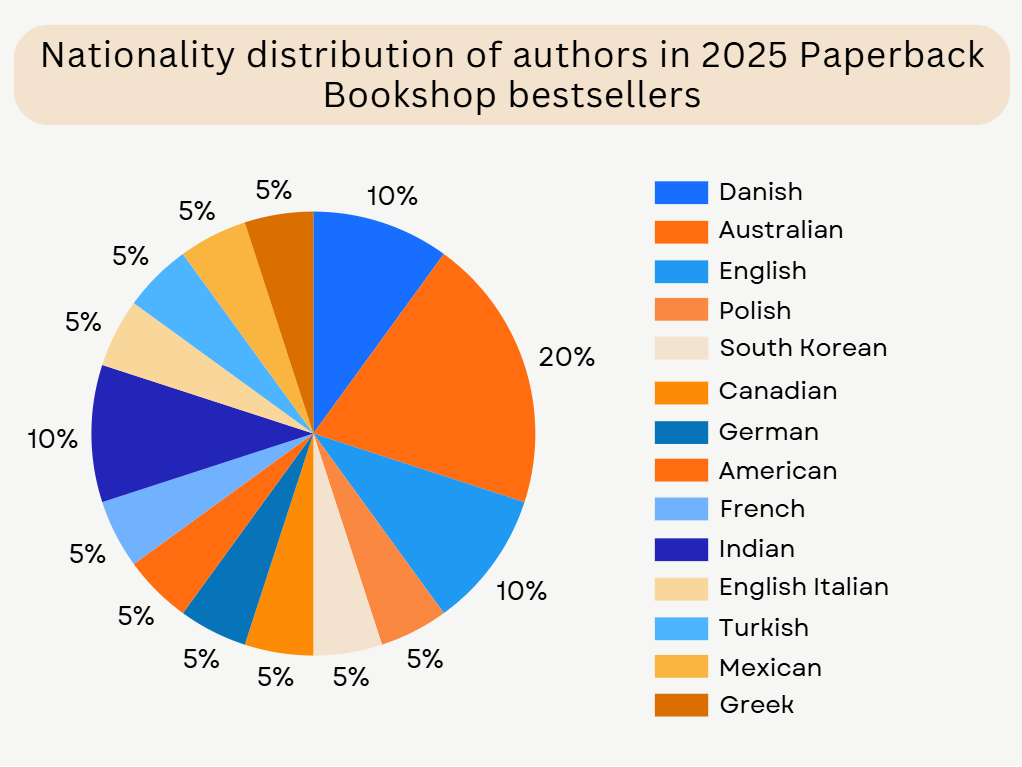
In Paperback’s Bestseller List, there is a significant number of translated works. Translated works from nine languages accounted for 50% of bestselling titles, with Danish and German the most common languages represented (after English, which was 20%) (figure 2). Furthermore, among the literary fiction bestsellers, only 12% were written by Australian authors (one book). The list therefore reveals not only a demand for literary fiction, but a particular interest in translated literary fiction.
MacDonald attributes the interest in translated works to staff preferences, the influence of the International Booker Prize and local presses—such as Giramondo Publishing—that actively publish translated fiction.
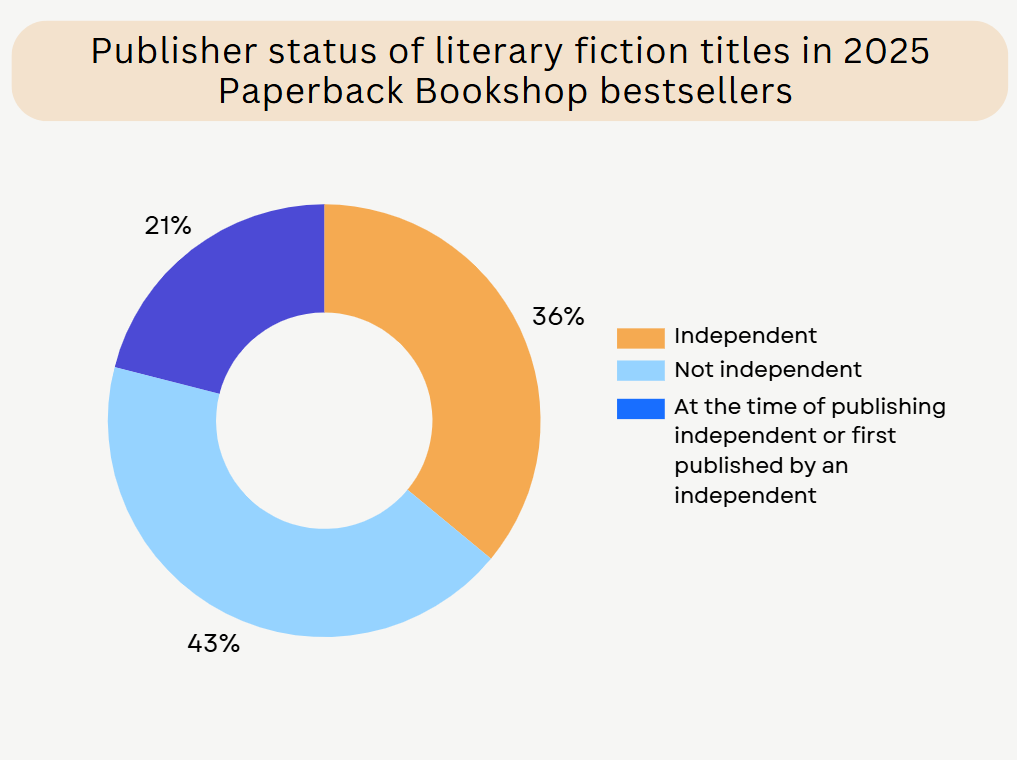
The ‘Big Five’ publishers published 43% of the Paperback’s literary fiction bestsellers, while 47% were published independently or originally released by independent presses (in the case of Text Publishing, some titles were published before its acquisition by Penguin Random House and have been classified as independent) (figure 4).
Independent publishers are doing all the hard work for the larger publishing houses, taking risks on innovative authors while larger publishers publish commercially predictable titles. It is possible that large publishers releasing translated backlisted literary fiction is another manifestation of this trend—choosing works that have already proven commercially successful in other languages/time periods rather than taking risks on new Australian literary fiction. MacDonald believes the Australian publishing industry is very risk adverse and ‘someone, somewhere has told publishers that “literary fiction” is hard, and people don’t want to read it.’ However, as the Paperback’s bestseller list demonstrates, ‘literary fiction doesn’t have to be hard. And people do want to read it.’
There remains a significant interest and consumption of literary fiction, however this is predominantly translated and backlisted fiction. This is, however, a small dataset and it provides only a snapshot of one bookshop and bookseller in a single year. The lack of comparative data makes it harder to draw broad conclusions about the wider state of literary fiction production and consumption. Additionally, due to the Paperback’s size, the stock is ‘very considered’ and specifically curated according to ‘what sort of books are most interesting to us and our regular customers.’ This often means The Paperback does not stock some national and international bestsellers, further complicating comparison. Even so, the Paperback’s bestseller list paints an interesting and optimistic picture of the understated interest in, and demand for, literary fiction that contributes meaningfully to the broader discourse.
Amplify Bookstore
The way in which the importance of cultural value impacts what books get published and by whom is an important and central line of inquiry which must be addressed in the context of literary fiction. Amplify Bookstore—a store committed to exclusively stocking books by BIPOC authors—stocks large numbers of literary fiction, which can be seen in Amplify’s online catalogue and April 2026 orders. Speaking with Marina Sano, co-owner of Amplify, provided brilliant insight from the perspective of a bookseller with a particular mission and lens.
The most popular genre ‘by far’, literary fiction takes up the majority of Amplify’s stocklist: 471 in stock titles available online (Fantasy is the next largest genre with 299 titles in stock). Though Sano notes there is never a large variety of BIPOC authored books in comparison to white authors, ‘out of what we can stock, literary fiction feels generally the most abundant.’ Across genres, ‘small presses tend to have a better showing’, regarding publishing BIPOC authors, Sano notes the ‘Big Five’ publishers: Penguin Random House, Hachette, HarperCollins, Pan Macmillan and Simon & Schuster are consistent (though provide ‘the absolute bare minimum’) across their smaller imprints.
When exploring the concepts of literary fiction’s perceived cultural merit, it’s important to reflect upon what kinds of stories written by BIPOC authors are deemed culturally valuable and are therefore published. Sano expressed diverse voices are at times ‘only being valued when they can be trotted out for awards and held up as some sort of trophy, even when there is next to no support from it internally or from the actual readership.’ Whilst literary fiction has become an incredibly popular genre and, in Amplify’s case, overall, the most popular genre, this may raise questions about what kinds of books BIPOC authors are being expected to write. Sano reflects on this, ‘if you dive into what books are being put forward and how that moves with cultural trends, it becomes clearer that BIPOC writers are being pushed into a model minority type of space where the books are only picked up because they have “literary merit” and that the books worth publishing are those that offer a greater sense of prestige.’ She goes further, addressing the style of stories being published, ‘this ties greatly into the commodification of trauma and struggle-based narratives at large, considering that literary fiction is really not a genre known for being particularly upbeat.’
Who’s publishing what?
When analysising Amplify’s stock, in the 471 ‘Literary fiction’ titles (as of May 11 2026), 170 were published by Australian independent publishers. It is worth noting, for the purpose of Amplify’s data analysis, there was no definition-based delineation made between ‘small press’ and ‘independent publisher.’ If a publisher is technically independent, they were listed. Only 40 literary fiction titles currently in stock were published by Australian independents, that is 23% of the 170 independent publishers and 8% of the total 471 literary fiction titles currently in stock. There were 12 Australian publishers who published these 40 titles and 19 of these 40 titles were written by BIPOC authors who are Australian or are based in.
Sano shared her own thoughts regarding the lack of literary fiction by BIPOC authors published by Australian small presses, ‘if we only stocked local authors, we’d be shit out of luck. There’s the brilliant work that Magabala does and some great offerings from local small presses, but the quantity of new books would be so, so slim as the best local work is basically all coming from small presses who necessarily publish fewer books.’ The data pulled excluded any imprint of the ‘Big Five’ publishers and titles by university presses were not gathered.
The ‘swallowing’ of small publishers
A large majority of the titles in Amplify’s literary fiction catalogue were published by smaller, originally independent publishers which have been acquired by one of the ‘Big Five.’ Text Publishing, for example, had a few titles present on Amplify’s list, though as it was bought by Penguin Random House in 2025, for the purposes of this study it no longer constitutes an independent publisher. This restriction heavily impacts the data and highlights the current landscape of the Australian independent publishing industry quite starkly. There has been a consistent ‘swallowing up’ (of small presses by large multinationals and as this dataset shows, this has had a direct impact on the representation wholly independent publishers have in the industry. In their article ‘Another publishing house gets swallowed, leaving Australian literature on shaky ground’, Menzies-Pike presents concerns over the true autonomy independent publishers maintain when acquired, and if their reputational and editorial integrity can remain intact. The space independent publishers who are not imprints of large multinationals take up on literary fiction lists shrinks considerably when excluding small presses acquired by large multinationals. In terms of Australian independent representation though, a positive takeaway from the research reveals Scribe Publications as the publisher with the most titles on the list (18 overall), though notably, none of the authors published by Scribe are Australian. Giramondo, whose titles on the list are all Australian authors, has 7 titles.
Sano privately shared data on their unique title orders for April 2026, with 27% of the titles classified as literary fiction. This data is a helpful (though limited in scope) snapshot of how literary fiction can come to fill Amplify’s shelves over time but not have an overwhelming volume when broken down into monthly orders from publishers. The only independent publisher Amplify ordered from in April was Allen & Unwin, and with five being literary fiction out of the seven titles, this further supports an argument towards independents consistently publishing more literary fiction than the large multinationals, in comparison to other genres.
Amplify Bookstore provides a valuable perspective into the current landscape of literary fiction, specifically those written by BIPOC authors. A key takeaway is the shortage of literary fiction by BIPOC authors published by Australian independents, in addition to only half of the titles represented by Australian independents being written by Australian authors. If the Australian publishing industry is going to take the cultural value of literary fiction seriously, a focus on filling the space with local authors from diverse backgrounds could be a positive approach.
The future of literary fiction
Australian small presses and independent publishers have established a unique genre-based position within the industry with either a focus on or large investment in literary fiction. There is a clear, statistically supported lean that small presses favour literary fiction in a way that large publishers do not and that independent publishing houses continue to sustain the genre of literary fiction through cultural prestige, editorial investment and highly engaged readership.
Many Australian small and independent publishers seem to have a particular focus on publishing literary fiction, however when assessing how this impacts the cultural identity of the genre within the Australian context, it becomes complicated. Whilst literary fiction is a popular genre amongst readers, there remains a prevailing issue of the lack of Australian authored books being published in the genre. Only a few of these publishing houses to consistently publish Australian authors of literary fiction.
Globally connected literary networks are what sustain the cultural identity of literary fiction within the publishing houses of Australia. Whether this reliance on international work is a necessity to maintain profitability, or a developed crutch that has solidified itself within the industry in favour of Australian works is worth a further interrogation beyond the scope of the research conducted. Contemporary Australian literary fiction is therefore not simply surviving through independent and international publishing networks but being actively redefined by them.