

Memories holding my hand
Marley Fountain
A while ago, I was visiting a beach. I had come there to write, and I did, sitting on a lichen-crusted bench. I looked down as the little flies gathered around my Docs. Gravel, clawing up from the dirt, had ricocheted past the bench’s timber frame, crawling onto the lawn, past borders drawn by unknown hands. I’ve been told that I lose myself to details. I heard a woman cheering behind me, and I couldn’t help but pay attention. She was with her kid, and he was on a bike twice his size, blue or green or red, and he had just ridden it alone. I didn’t see their faces, so I can’t describe them, but I smiled, without teeth, without them noticing me. I was a dot against the sea’s horizon, on a cliffside with the flies. And I looked out to Point Danger, over Cosy Corner, over the beach in front of me, over the tips of the trees. I stared at the words on the page, letters trying to capture time.
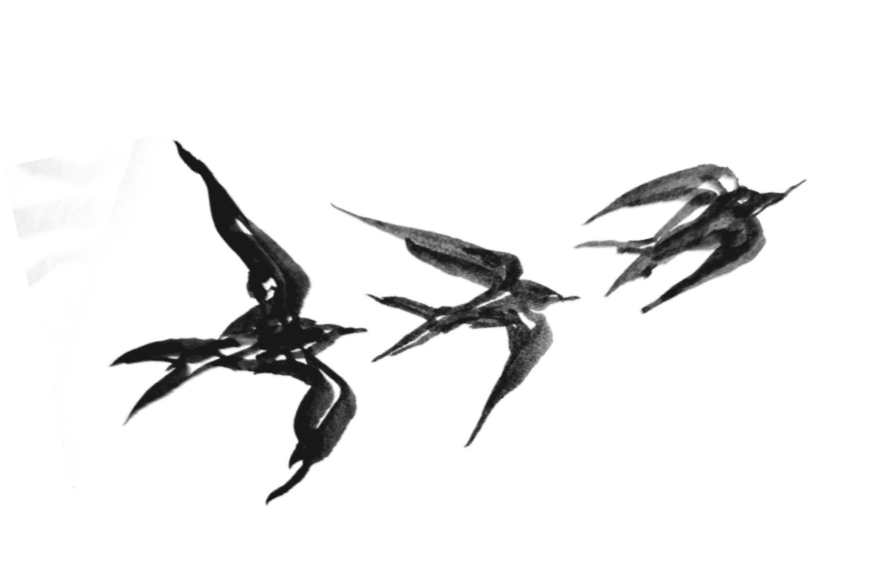
The sea birds ducked below the clouds, black cut-outs on the canvas. I thought about the frames made in films, the stills of motion, one after the other. Their wings extended, bending down, and down, before straightening and repeating the movement upwards, then downwards, on and on until they eventually land. I saw these frames laid out next to one another in a grid—spaces emerged around them, connected like tubes, a web holding their being.
I’ve collected shells for as long as I remember. Jars upon jars of them. Some were gifted—it turns out my family collect these spiralling exoskeletons, too. A nesting habit, maybe? The act of it feels strangely intuitive. Perhaps they, too, feel this tug, collecting things just because.
I had a granny who collected things, too, but her things were owl things. I speak of her in past tense because she is dead, in my mind, at least. I don’t think I’ll speak with her again. And I don’t like owls anymore.
Everyone in the house was tucked away in their nests, and a barn owl had just run into the glass sliding door that separated our living room from the backyard. We had been living in Victoria for a year at this point. It was dusk, the light trickling in with a navy hue, and the barn owl fixed its orbs on me between the pillows of the mouldy patio couch—two mirrors of the void, enshrined with a heart of feathers. My family still don’t believe it happened, because nobody saw its face but me.
On bikes I could escape, my legs shifting the peddles up and down, on and on, until Mum shouted at me to come back. I wouldn’t. I would just wait for them to catch up before flying again.
‘Fly, you fools!’
I don’t think I would be able to go on if I were Frodo. And as I watch this scene for the millionth time, I can’t believe that I would ever mistake Gandalf’s line for ‘run, you fools’.
I heard that the billionaires are building doomsday bunkers in the Australian desert. You’d think they’d try a more subtle admission of guilt, but I suppose they’ve offloaded all their brainpower to AI and their underlings by this point. A pity that they can’t watch the sea as the nukes vaporise them. Nothingness must feel filling when money seeps from their bloody hands, like the empty shaft of a loaded gun, residue tacky against the metal, waiting to be used against the people who made them. Children in suits, pigs with ties, boys and bullets and beaten immigrants. Smaug is so much cooler than these tiny men, plus he’s a dragon! And, on top of that, played by Benedict Cumberbatch.
A meditation exercise: As you lie down, arms out, palms open to the sky, legs relaxed, feel as your body dissipates into root. Down down in spiral tendrils, down down into the earth …
Now, as your body is vanished into energy, expand your mind to the building … then to the town … then to the country … the planet … then finally, to nothing.
It’s a painful thing to see the family you once loved decide that your particular branch is inadequate. Something to be stomped out and left homeless, little flies crushed into gravel. Imagine me standing at the front door to my old house, childish hands gripping each other, my granny behind the mesh threshold. Her face had gotten wrinklier in the past year, her personality even more sour. That mind of hers was disappearing, but she had somehow remembered that I was now thirteen. I didn’t let her in, so we spoke at the door, her on the outside looking in. Happy birthday. I didn’t smile. She gave me a gift. Thanks Patricia. She left. No hug.
The empire looks evil on film, so how come everyone loves to suck them off in real life?
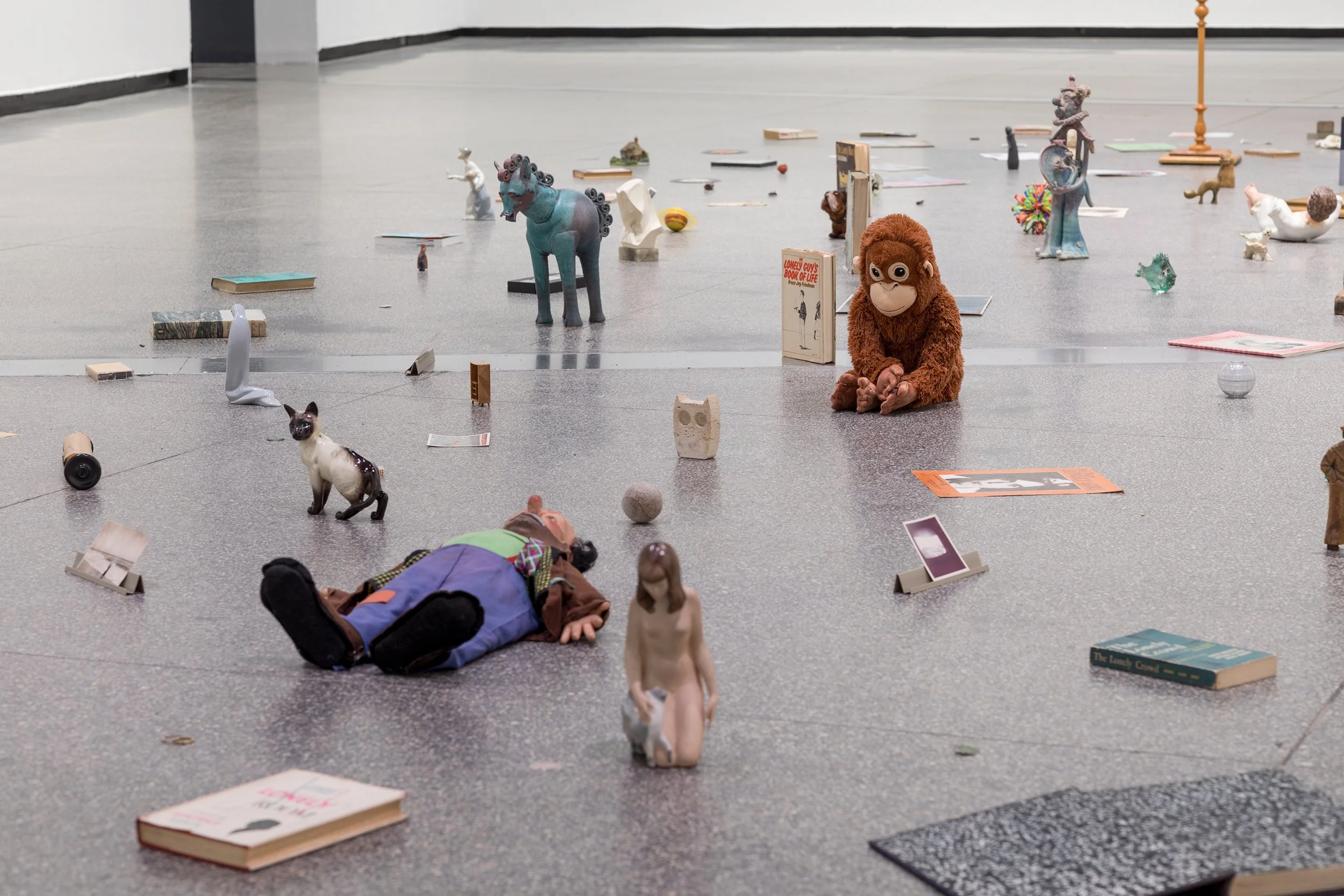
When I look back to the objects, I see their porcelain eyes. I see how their value is abstracted in this collection of things, their old frames colliding against the new. Mostly, though, I see how they have found stillness. A resolve, I guess. It’s tempting to think that they’re lonely away from home. And I do. And the tips of trees are, but they have the wind with them. And the wind picks up the feathers in sea birds’ wings. The tides sweep the seaweed onto the shore. The gum trees drop their gumnuts. And the collections of things find collections of things in a collection of things in nothing. Stars eat stars eat stars eat stars, and feathers find themselves a place in my collection.
I threw the gift in the bin. I don’t know if I opened it. Before she knocked on the door, before she drove up to the property over hills and bridges, I had decided that she no longer deserved the title of ‘grandmother’. I don’t like owls anymore.
Sometimes, I yearn to be a speck of dust. At least then I could travel the world for free. Moneyless and happy in the arms of Earth herself.
I want to say that I have hope that the world will be okay, but it’s hard to believe that when the children are burning, and as lead punctures flesh. Maybe the bunkers are a protection from a reset. One red button away from nothing. They don’t deserve a reset, though.
Did you know my middle name is Hope?
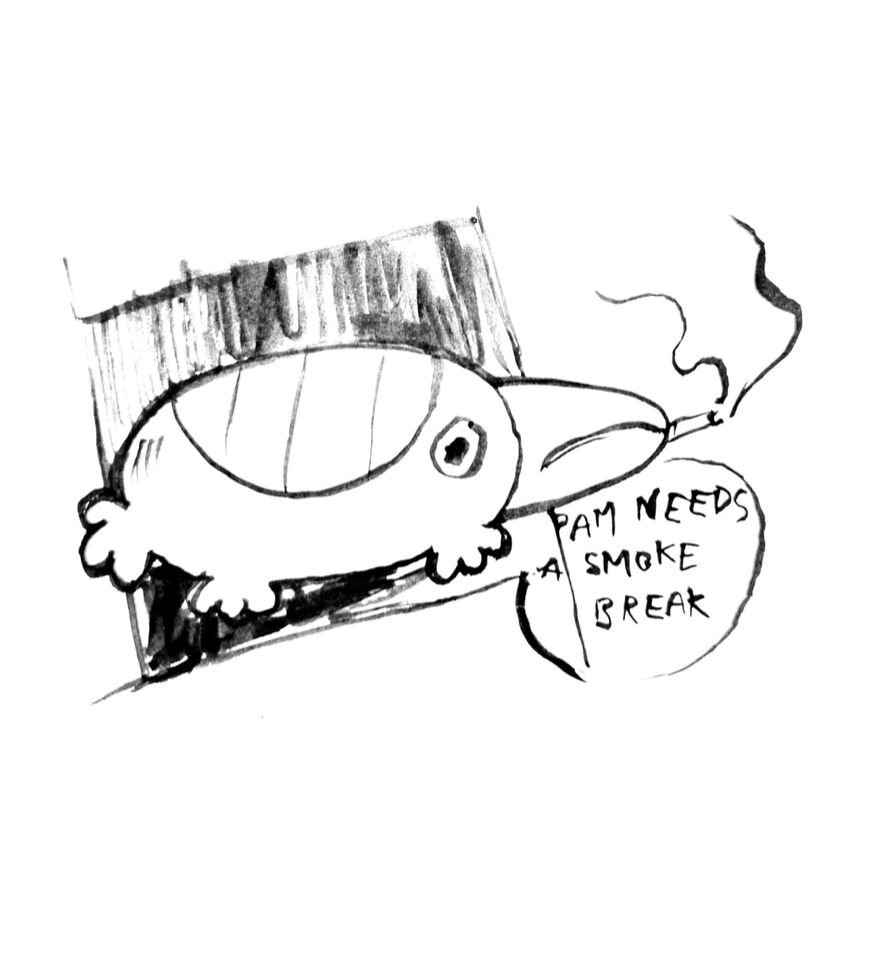
I count the ‘Pam the birds’ when I head to the city. The artists use the scaffolding on the bridges as canvases. The birds move up and down ever so slightly as I move with the train. I imagine it is a collaboration of artists doing this. Do they know why they do it?
I count the rusted cars when I head to the city—skeletons of amber metal left strewn across the plains of seemingly endless yellow grassland. Through the spaces left by the windows, miniature paintings emerge, angles of the world captured in the frame of these old cars. If this land belongs to the government, do these cars belong to them as well? Like my name, written on paper, scattered across databases, on and on. Do I belong to my name or does my name belong to them?
There is no countdown for 1.5 degrees anymore and Nepal has just been waterboarded. A few videos fell on my for-you page for about 3 days, and then nothing. My algorithm went back to climate change doomism, Pauline Hanson and theories on the new Spider-Man movie. Mass surveillance is good if you are good. So if Peter Parker catches the bad guy with it, so can they, because they are supposedly good.
We would sit down at our desks after standing outside in the humidity. I had this art teacher named Jane (we used to call teachers by their first names there), and she was a witch. She would wear fish sandals and purple sequined cloaks as she hobbled into the room, leaning on her staff. For this class, she had a singing bowl. And for the first 10 minutes (usually it was 5 minutes per class), we meditated to the ringing of the universe. Sound, pulsing in my head, so loud I could almost forget what Mum had told me that morning.
On Sunday I ran into the sea. It was 11 degrees, overcast, and the sand squeaked under my heels as I closed the distance with the ocean and me. I ran and ran and the water could not restrict me. I want to say I dived, but I think I stumbled. The cold was painful. And I still feel it now, under my skin, rippling. Heat sinks into muscle but skin cools. There’s an in-between, a transition, so that when my skin finally warms once again it feels, different. Heat sinks, I sink and the cold forms a barrier—and it’s moving.
Trees blur on moving trains and the canola fields are pools of sulphuric yellow. Rows and rows of buds on buds.
Meditation exercise: Listen to the sound as it branches out out into the air.
‘Don’t let anyone one but Dad or I pick you up from school anymore.’
Listen to the chirps, the humming, the language of fairies reverberating in the room.
In the gallery, I sit and feel the sounds create waves in the vision of my mind’s eye. Expanding, sinking, upwards, downwards, outwards, inwards. I sit and watch the flies/birds/moths on the screen in the dark room. I’m falling asleep so I sit with the museum of objects. The artist calls them the Museum of loneliness, but they aren’t lonely, because I’m with them.
I have a friend that sees her memories as files to be archived and recalled. She can recall them at will and remembers almost everything. She has aphantasia—she has no mind’s eye—so they are just … thoughts? I can’t conceptualise it, but she can conceptualise memories being conceptualised in their complete paintings. I see my mind as a web.
I tilt my head at the objects, staring back at them, then looking to the door, to the receptionist, to the road and the other roads and the NGV and the clouds … stars … nothing. And to Nepal. And the people in private jets. Lands laden with corpses and buildings with no roofs. And the nuclear weapons. And the flies back home. And the sound rippling like waves. The cold is under my skin and I can feel it breathing for me. I feel sick, now. I feel sick and I see them all moving upwards, downwards, outwards, inwards, everywhere as a collection. As the collection. The universe runs away and the stars squeak as they are ripped apart by black holes.
Apparently, Einstein theorised the possibility of white holes. Like black holes, but they’re throwing things back into our universe. That would mean that black holes are portals to other worlds and, theoretically, we could travel to them. A new collection of things. But I wouldn’t trust any of this information because I think I got this from a YouTube video.
I have hope that the good good will ‘win’. But before that the sea will take some more with her. But I don’t hate her for it. It’s not her fault.
There’s rain on the train window and the clouds creep in over the gallery and back home, in NSW, the sun decides that September would be summer. The birds’ wings go up up up, down down down. Frames are still on the gallery floor. My granny drives away from the property for the last time. And the graffiti tells me to smile. I do, with my teeth, at the stars because I feel them rippling under my skin.
And I find myself in a collection of things in things, and my memories hold my hand as I step out onto the concrete pavement outside the gallery.









Marley Fountain (they/them) is a writer and comic artist studying their craft at RMIT. Combining visual art and creative writing, they are drawn to the intersection of the natural and technological, often exploring it through an ecofeminist lens. Currently Marley is working on their own comic, aiming specifically to focus on these concepts further and with hope.
Image credit
Patrick Pound, The museum of loneliness 2026 (detail), installation view. Commissioned by Australian Centre for Contemporary Art, Naarm/Melbourne. Courtesy the artist, STATION, Naarm/Melbourne, and Darren Knight Gallery, Gadigal/Sydney. Photograph: Andrew Curtis.