INTERSECTIONALITY

The Stella effect: The ongoing recognition of women and non-binary authors in the Australian literary landscape
Phoebe Smallwood, Gaia Varone and Jessica Walsh


The Miles Franklin, established in 1957, finds its prestige in its long history and influence on the Australian literary canon. The Stella Prize, named after the same author and established in 2012, was born as a reactionary response to the Miles Franklin and, in general, to an industry that has primarily favoured male authors as literary prize winners.
The year the founders of the Stella Prize sat together to work on a new literary prize exclusively dedicated to women writers—extended to include non-binary authors in 2019—was the same year the shortlist for the Miles Franklin Award consisted solely of novels written by men. The problem wasn’t the 2011 shortlist alone, but rather the repetition and reinforcement of a longer trend that had been present in Australia’s literary landscape since the first literary prize was introduced.
Literary prizes are key factors in the complex ecosystem that shapes perceptions of worth surrounding a book or an author, as well as the literary landscape they inhabit. But prizes alone do not possess the same power as reviews in introducing and promoting books to a wider audience.
With reviews still playing a key role in the distribution of Australian books, we questioned if the creation of a separate ‘playing field’ for women could bring about genuine gender equity, and if this separate field would make the prize less ‘legitimate’ compared to, for example, the Miles Franklin Award.
Our findings showed that since the Stella was established, the percentage of women writers shortlisted and awarded the Miles Franklin drastically rose; in 2020, the Stella Count recorded that gender parity had been reached with almost equal, if not more, book reviews being published on books authored by women.
The question then became: how has the introduction of the Stella Prize furthered the recognition of women and non-binary authors in the Australian literary landscape? We have tried to answer this by completing three case studies to assess the ongoing influence of the Stella Prize on different forms of published media, while also filling in the temporal gap between 2020 and today.
While studies on the initial effects of the Stella Prize up to 2020 are abundant, there is little recent data-driven literature that further discusses the topic. Moreover, even though the Stella Count reprise was announced in 2024, to this day, the most recent available version refers to a dataset dated back to 2020.
Where are the great women writers?
Despite the Miles Franklin’s self-proclaimed prestige, the historical underrepresentation of women writers among the Miles’ winning titles has raised both questions and criticism for the award’s main purpose: to determine each year’s novel ‘of the highest literary merit that presents Australian Life in any of its phases’.
Between its conception in 1957 and 2012, a woman was awarded the Miles Franklin Literary Award only 14 times. Of the first 55 winners, only 25.4% of winning novels were written by women. In contrast, in the following 13 years, the percentage of women writers winning the Miles Franklin rose to 83.3%.
We can only speculate whether the judging panel’s interpretation of ‘Australian Life’ has shifted over time, but what the drastic rise of awarded works written by women can be attributed to is the first Stella Prize awarded in 2013.
Beyond acting as an emblem of literary merit, the Stella Prize strives to provide women and non-binary writers with not only critical recognition but also awards ‘significant funds directly to writers’ to help them towards publishing their next book.
Securing longevity in cultural discourse
Like any other for-profit industry, publishing relies on sales and funding. Literary prizes generate attention, which directly translates to economic value. As Sarah Holland-Batt wrote in 2018, ‘With visibility comes sales, and with sales comes a greater longevity for a writer’s career.’ Therefore, prizes such as the Stella, by drawing attention to women and non-binary authors, support their ongoing careers.
In a society where authors are often underpaid, the book sales generated by literary prizes, as well as the associated prize money, allow authors to dedicate more time to their craft.
Beyond women writers’ historical underrepresentation, the impact of a literary prize’s perceived prestige can also be illustrated when measuring the amount of critical acclaim a winning title receives after its win, and in totality.
Drawing from the shift in attention towards women writers since the Stella Prize’s conception, we compared both the Stella Prize and Miles Franklin Award’s 2013 winning titles: Carrie Tiffany’s Mateship with Birds and Michelle de Kretser’s Questions of Travel. Assessing the volume of critical attention each title received through articles and reviews, the power of literary prizes can be determined as a direct factor in which voices are being critically recognised.
We adjoined the term ‘critical acclaim’ with reviews and articles as they act as reflections of the public sphere and ‘“build careers and reputations” and are vital to author’s public profile and sales figures’.
We focused on 13 of the Australian publications assessed in the 2013 Stella Count:
The Advertiser, The Age/The Sunday Age, The Australian, Australian Book Review, Australian Financial Review, Books+Publishing, Courier-Mail, Daily Telegraph, Good Reading, The Monthly, The Mercury, Sydney Morning Herald and The West Australian.
Our selection of primarily metropolitan and state-published newspapers was made in adherence with the publications the Stella Count deemed key in regard to book reviewing.
We’d like to preface that all reviews and articles counted are limited to those available on the respective publications’ websites. It is therefore not entirely representative of the volume of praise, criticism and conversation stirred by the winning titles.
Book reviews or articles that were published after the title received its award must have been published within 6 months of the announcement and include both the name of the winning title and the name of the respective award to be counted. Articles that solely mentioned the titles in announcements of longlists and shortlists have not been counted.
Of these 13 publications, only 6 reviewed or discussed both texts at least once. Five of the selected publications didn’t review either title. The 2013 Miles Franklin winner, Questions of Travel, received a total of 18 articles/reviews published over 8 of the 13 publications. For the Stella Prize winner, Mateship with Birds, 11 articles/reviews published across 6 of the 13 publications.
Approximately 61.1% of reviews/articles on Questions of Travel were published after it won the Miles Franklin Award, and approximately 54.5% of Mateship with Birds’ critical acclaim was published after its Stella Prize win.
The increase in critical acclaim each title received after being announced as a winner identifies the important role literary prizes can play in uplifting historically underrepresented voices. Without winning their respective awards, over half of each title’s critical acclaim would not have been published. As stated by former Stella Prize board member: Sophie Cunningham in 2018, ‘it is harder to disappear women from public life if they have been shortlisted or won literary prizes’.
Growing critical attention indicates the importance of ‘prestigious’ literary prizes in showcasing the underrepresented voices of women writers. Most of the surveyed articles and reviews were published after or because of the books’ win. Without that symbol of prestige, these two titles may never have been reviewed in some publications and would have received considerably less publicity and critical attention overall.
After 2020: Reading the Stella Count
The Stella Count began in 2012 as an annual, data-driven research project that measures gender representation in literary book reviews in Australia. As the Stella Prize was preparing its ground, the Count immediately positioned itself as essential to the cause the Prize was built around, which was—and still is—being an advocate and a catalyst for gender equity in the Australian literary landscape.
After having seen how the early results of the US-based VIDA Count, after which the Stella Count was modelled, showed a significant disparity between the numbers of women’s books that had been published or had been reviewed in the US market, the organisation behind the Prize knew they had to bring that same kind of transparency if they were to actually shift the biased practices of the publishing industry.
The Stella started their count in conjunction with Books+Publishing by analysing only the number of reviews in selected Australian publications that were written about women’s books rather than men’s, but throughout the years, they broadened their scope.
As of the latest Stella Count available from 2020, the analysed dataset shows numbers for the gender of the authors whose books are reviewed, the gender of the reviewers, the relation between the length of the reviews and the gender of the book authors, and the relation between the genre of the reviewed book and the gender of the book author.
Extrapolating data from 12 Australian publications ranging from national, metropolitan and regional newspapers to literary journals and magazines—both printed and online. We found the 2020 Count reinforced a trend, of raising the percentage of reviews of books authored by women by two points, from 53% to 55%.
Of the 12 publications considered, only two, The Australian and Australian Book Review, still struggle to reach and surpass the 50% threshold, though, as noted by Monash University researchers Melinda Harvey and Julieanne Lamond in a 2022 study, these publications not only have a very wide national and international audience, but also publish, combined, 29% of the total number of reviews considered by the Stella Count.
As we observe the sustained impact the Stella Prize has had on the Australian literary landscape since its establishment, we wanted to assess how the trend identified by the Stella Count in the number of reviews of books by women authors has continued after 2020, covering 2021 to 2023 and taking into account 4 of the 12 publications considered by the Count:
The Monthly, Australian Book Review, the Sydney Review of Books, and The Saturday Paper.
These publications all have a cultural and literary focus, and offer an interesting range of performances as of 2020, with the Sydney Review of Books ranking one of the highest in the latest Stella Count, with 70% of its reviews being of books written by women; The Monthly and The Saturday Paper following behind with, respectively, 56% and 61%; and Australian Book Review with 43%, the only publication whose representation of women authors has been trending downwards since the Stella Count begun. Daily newspapers are not included in this analysis as their archives were not as easily accessible or as immediate to filter through.
The Monthly
If, in the first five years since the Stella Count began, The Monthly’s numbers were disappointing, from 2016 onwards—year in which the quota first passed the 50% mark—the magazine demonstrated a substantial increase in the proportion of reviews devoted to books written by women authors. The most significant improvement was recorded in 2019, with an all-time record of 63%.
This represented a dramatic change that positioned The Monthly as one of the strongest performers in gender representation. Indeed, despite a slight decline in 2020 and a single sharp drop in 2022, the proportion remained relatively stable after that, indicating a long-term commitment to greater gender parity in the magazine’s review coverage.
The Saturday Paper
Just like The Monthly, when The Saturday Paper was first included in the Stella Count in 2015, only 36% of the reviewed books were written by women, highlighting a significant gender imbalance. A decisive shift took place three years later, in 2018, when the figure rose to 51%, achieving equity for the first time. The upward trend continued into 2019, when women-authored books accounted for 66% of all reviews, the highest share to date. Although the percentage declined moderately after 2019, it remained consistently above parity with figures over 55%.
Even in this case, it seems like the eyes of the Stella Count prompted what can be considered a sustained institutional change towards greater gender equality in the literary review practices of the publication.
Sydney Review of Books
If the Sydney Review of Books showed a similar slow start in 2015, the numbers demonstrate a quicker increase in the representation of women authors in its reviews, reaching parity at
50% in 2018. Since then, the magazine established a solid upward trend that culminated in 2020, with 70% of the reviews dedicated to women authors. Although the percentage declined after 2020, it remained substantially above parity, reaching its lowest point in 2022 at 54.5%.
Within five years, Sydney Review of Books achieved an outstanding result by almost doubling its initial number, demonstrating the publication’s commitment to gender representation.
Australian Book Review
Of all the publications, the Australian Book Review remains the magazine with the least evidence of sustained long-term improvement in the representation of women authors. Although the publication showed a slight recovery from 2016, the growth was not sustained, as it continued to fluctuate below the 50% mark in the following years, even after 2020.
It is important to note that Australian Book Review reviews a wide range of titles, from scientific and political nonfiction to poetry collections and young adult fiction, offering a solid cross-section of the literary landscape.
The Stella Count’s eyes
Except for the Australian Book Review, which shows a stubbornness over the years in keeping its number of women authors’ book reviews below the median, other publications seem committed to stabilising the trend already identified by the Stella Count.
Despite the post-2020 fluctuations, only 2022 showed a noticeable decline in the proportion of reviews devoted to books by women authors. Given its consistent presence across all publications considered, though, the pattern suggests that the decline may reflect broader, industry-wide factors.
As researchers Harvey and Lamond also suggest in their analysis, it is safe to speculate that the introduction of the Count had a significant impact on the industry’s awareness of the gender inequality patterns that are present in the industry itself.
Financial analysis
‘Suddenly I had money in the bank that meant I could pay the mortgage and buy food.
And I was a single parent by then again … I thought, “I reckon I can make that work”’.
She claimed that the success of the resultant novel, Bruny, wouldn’t have been possible without the financial support of the Stella. The Stella, unlike many Australian literary prizes, also pays authors for their participation in events and publicity, and therefore ‘acknowledges the value of women's time’.
By supporting women writers financially, the Stella Prize grants them the time and peace of mind to pursue their creative endeavours, leading to the crafting of great works and furthering the recognition of women authors in the Australian literary landscape.
Conclusion
In 2018 Sarah Holland-Batt argued that although the Stella generates valuable visibility for women authors, we should be wary of the term ‘women’s writing’, as the modifier positions female authors as deviations from a male standard. But while it is important to maintain a critical spirit, as we observe the effects of the Stella Prize, the changes caused by the establishment of the Stella are not only sustained, but also ongoing.
The fear of women’s writing being relegated to the realm of subgenre is continuously being dispelled by the efforts of the industry as a whole—whether they are actively enacted or are consequences of other dynamics—echoing Chatfield’s findings in her study about the establishment of the Women’s Prize for Fiction in opposition to the Booker Prize in the UK in the mid-90s. The creation of new literary prizes dedicated to specific categories is as much a symptom and a signifier of the industry’s prejudicial issues as it is an effective way to generate validation and recognition through the cultural legitimacy conferred by the prize itself.
Though the way the perception of ‘women’s writing’ as a term has changed—from potentially oppressive, to more widely welcomed—was not in the scope of our report to explore extensively, we believe this to be an important point of research to be conducted in the future, as it will reveal the ways in which the culture has shifted and how it has been reshaped. We further believe that continued analysis of this reshaping, as conducted by much wider-reaching annual reports such as the Stella Count, is imperative in maintaining an ongoing, reflective discourse that continues to evaluate the shifts within the literary landscape.
What we can affirm for now is that the Stella Prize, after 14 years, continues to prove successful not only in legitimising the voices of women authors but also in guaranteeing that they are given equal space and value.
The financial benefits of winning the Stella reach well beyond its $60,000 prize. Book sales also increase significantly. Louise Stark, the CEO of Hachette Australia, stated that the Stella ‘wasn’t just a prize about women writers, it was actually a prize that sells books’.
According to Nielsen BookScan data, in the week following Claire Wright’s win in 2014, sales for The Forgotten Rebels of Eureka increased by over 1800%. Similarly, in 2016, sales of Charlotte Wood’s The Natural Way of Things grew by 235% after winning. In 2022, Evelyn Araluen’s Dropbear became the first poetry collection to win the Stella and saw its sales increase by 832%. From 2013 to 2022, sales of winning titles increased by an average of 875%.
This financial boost isn’t limited to the winning titles. According to the 2024 Stella Annual Report, sales of shortlisted books nearly doubled following their recognition by the Stella. In the same year, longlisted books saw, on average, a 268% sales increase following the announcement of the longlist, a 153% increase following the shortlist announcement, and a 56% increase after the winner—Alexis Wright’s Praiseworthy—was declared.
Bestseller lists: the Stella and the Miles Franklin
Jo Case, Stella Prize co-founder, stated, ‘the sales figures suggest that the Stella Prize now sells the most books of any Australian literary prize’. However, although the Stella undoubtedly provides an economic boost, the Miles Franklin—generally regarded as the Stella’s greatest competitor—also has a significant financial impact on the market.
Readings Bookshop, an independent book retailer based in Melbourne, publishes an annual list of the 100 bestselling titles from across Readings’ nine bookshops, and is the only Australian book retailer that regularly does so. It is worth noting that prior to 2021, Readings still included children’s and young adult books in its Top 100 list, while now it exclusively features adult titles.
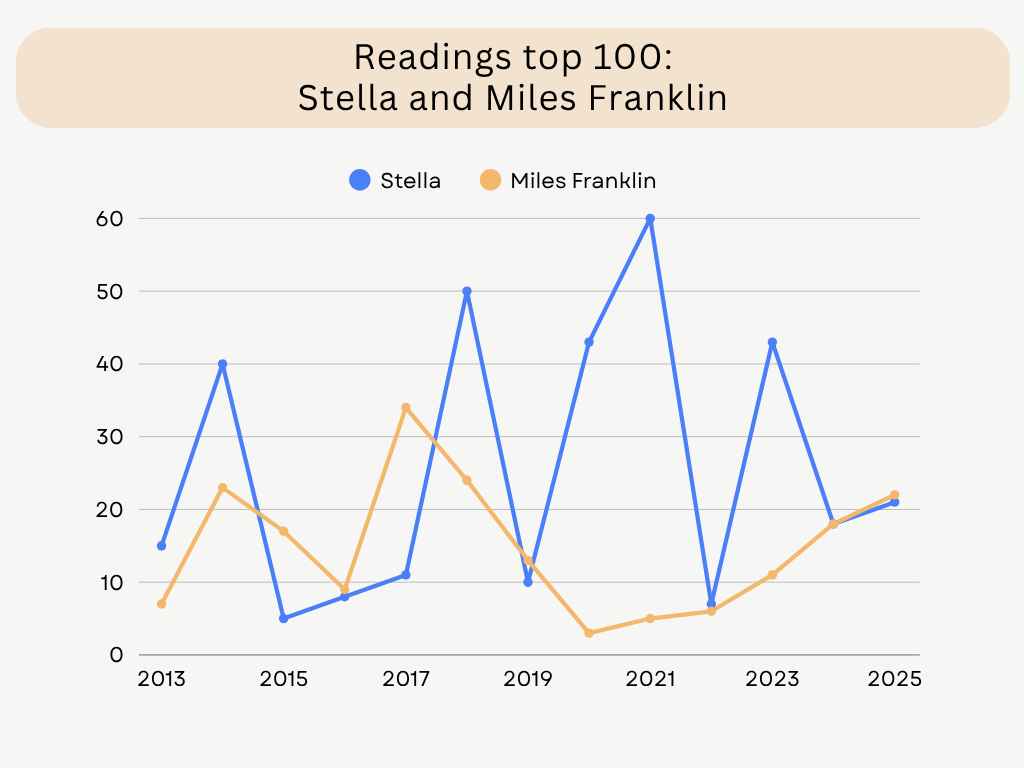
Winning the Stella ensures a place on Readings’ Top 100 list, although the exact position varies significantly. All but the 2021 winner—Evie Wyld’s The Bass Rock—were present in the top 50. Over the Stella’s thirteen-year history, the average position of the winner is 24.5.
Given the many thousands of titles listed in Readings’ online catalogue, this figure demonstrates the strong influence the Stella Prize has on the literary market. The Miles Franklin winners, however, average 14.8, suggesting that Chase’s assertion—that the Stella is Australia’s most influential literary prize in terms of book sales— may be exaggerated.
The trendlines pictured above suggest that the Stella’s influence is gradually decreasing, while that of the Miles Franklin is growing. However, this data only represents the impact of the two prizes on one specific bookshop chain, and so may not accurately reflect the larger literary market in Australia.
What winning means for the individual
The benefits of winning the Stella are far-reaching. According to a 2022 survey, Australian authors earn an average of $18,200 annually from their creative work, a figure well below the poverty line. But, in a society where most authors struggle to earn a living from their writing, winning the Stella ‘can literally buy them time to write their next book’.
Charlotte Wood, the 2016 Stella winner, stated that the prize money allows authors to work on their writing ‘without the extraordinary financial and attendant psychological strain most artists live beneath’. For Evelyn Araluen, winning the Stella allowed her to cut down from working three jobs to two.
In a society where women perform more than their fair share of unpaid domestic labour, time is a precious resource, the money from winning the Stella buys them that time. For Heather Rose, winning allowed her to pursue writing full-time: