
THE HEIRLOOM
WORDS BY ANTHEA GANNON
When Anthea’s grandmother died, she inherited a curious heirloom full of family memories. It’s a cookbook that tells the story of her family, and of Australia’s culinary history.
I acquired my family’s most valuable heirloom, if not by stealth, by keeping very, very quiet. I’m taking a huge risk writing about it. An aunt or cousin may challenge me for it and I don’t want to give it up.
At the time of her death, my grandmother was living with my mum. She had given away most of her jewellery by then, a piece to each of us. Her assets were shared between her three daughters and the rest of her worldly possessions stayed in the house, including her cookbook.
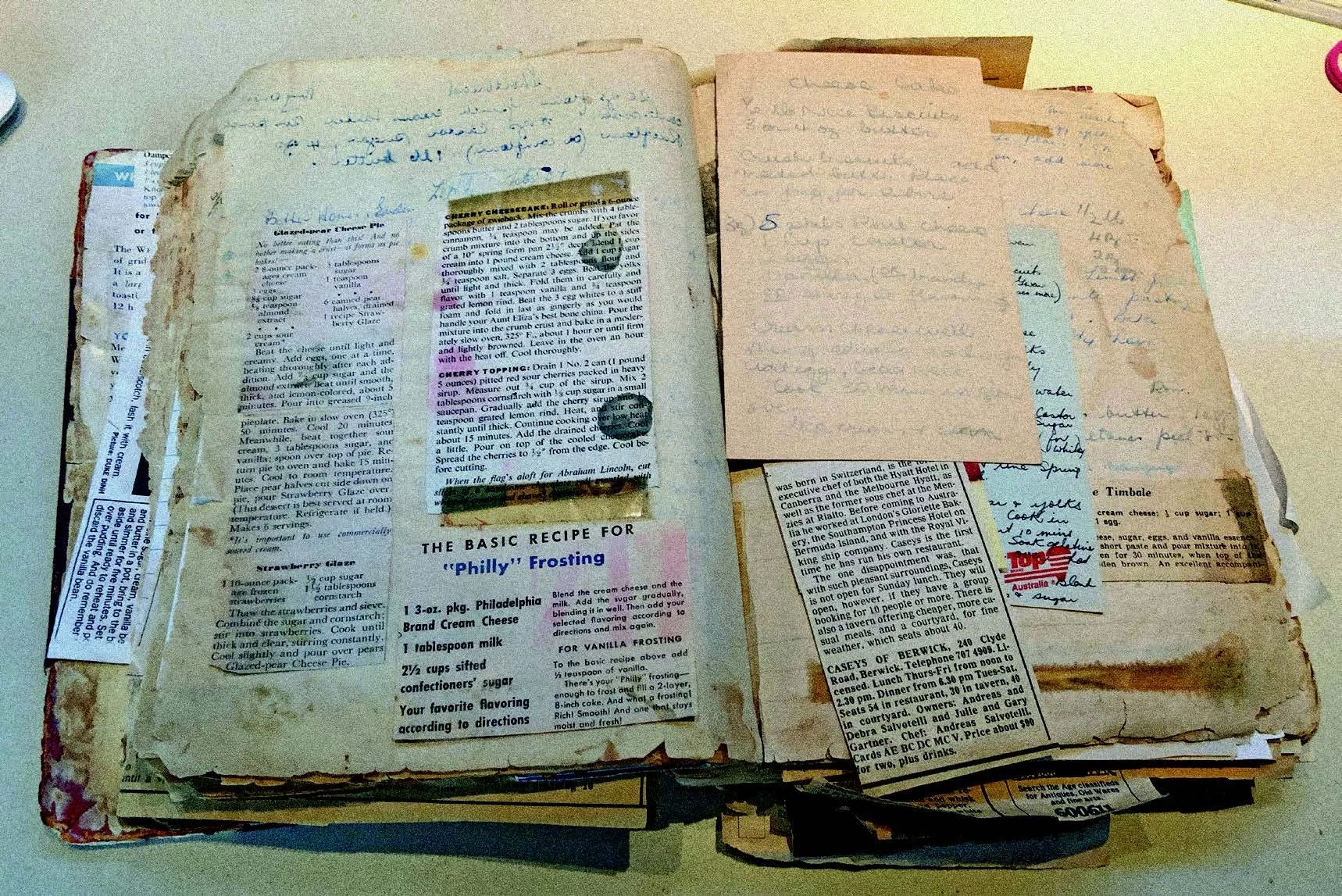
It has a brown faux leather cover that is no longer attached, with the word Recipes embossed in block letters. Most of the red binding and corners have worn away. It has seen better days. The book bulges with newspaper and magazine cuttings, some shoved in, others glued or stuck with now-yellow tape. Among them are recipes in my grandmother’s handwriting, neat cursive in blue biro.
Most of the family coveted the book. We all identify as foodies, we’re all influenced by our matriarch. One Christmas I planned to sit with my grandmother to go through the book and transcribe the family favourites. I never quite got around to it.
My grandmother, Issie, was a spectacular cook and a generous host. Her Christmas biscuits were more exciting than anything Santa came up with, except for the time he brought me a pony but that’s a story for another day. She would fill jars with at least four types of biscuit, making sure she gave each of us the ones we loved best, often adding a wedge of panforte to the selection.
I started helping her with her Christmas baking in my late teens, when I was at university the first time around. Issie had hurt her shoulder and couldn’t mix large batches, so I volunteered.
Before we started, Issie would plan exactly what we would bake and the quantities of each. So meticulous was her preparation, I am convinced that had she been a few years younger she would have created a planning spreadsheet for her bulk kitchen endeavours. When I would arrive she would already be in the kitchen, apron tied, blocks of pre-weighed butter sitting on the bench softening. She had usually started to weigh out the sugar and flour.
The first biscuits we baked together were the shortbread. She told me to wash my hands, then handed me a large plastic basin with a couple of kilos of butter and a small mountain of sugar and asked me to cream it. I looked for the mixer. ‘No, mix it with your hands,’ she told me. Unimpressed, I continued to look around for the hand beater. It was going to be a long day. ‘No,’ she said carefully, ‘use your hands, your bare hands.’ What? I wondered. Could she be serious? Yes, she was. I stuck my hand in, butter squelching between my fingers. We baked trays of shortbreads, tossed almond crescents in icing sugar while still warm and got the pud started.
When my mum died and I packed up the house, I spirited away Issie’s book to my place. I didn’t ask permission or tell anyone I was keeping it.
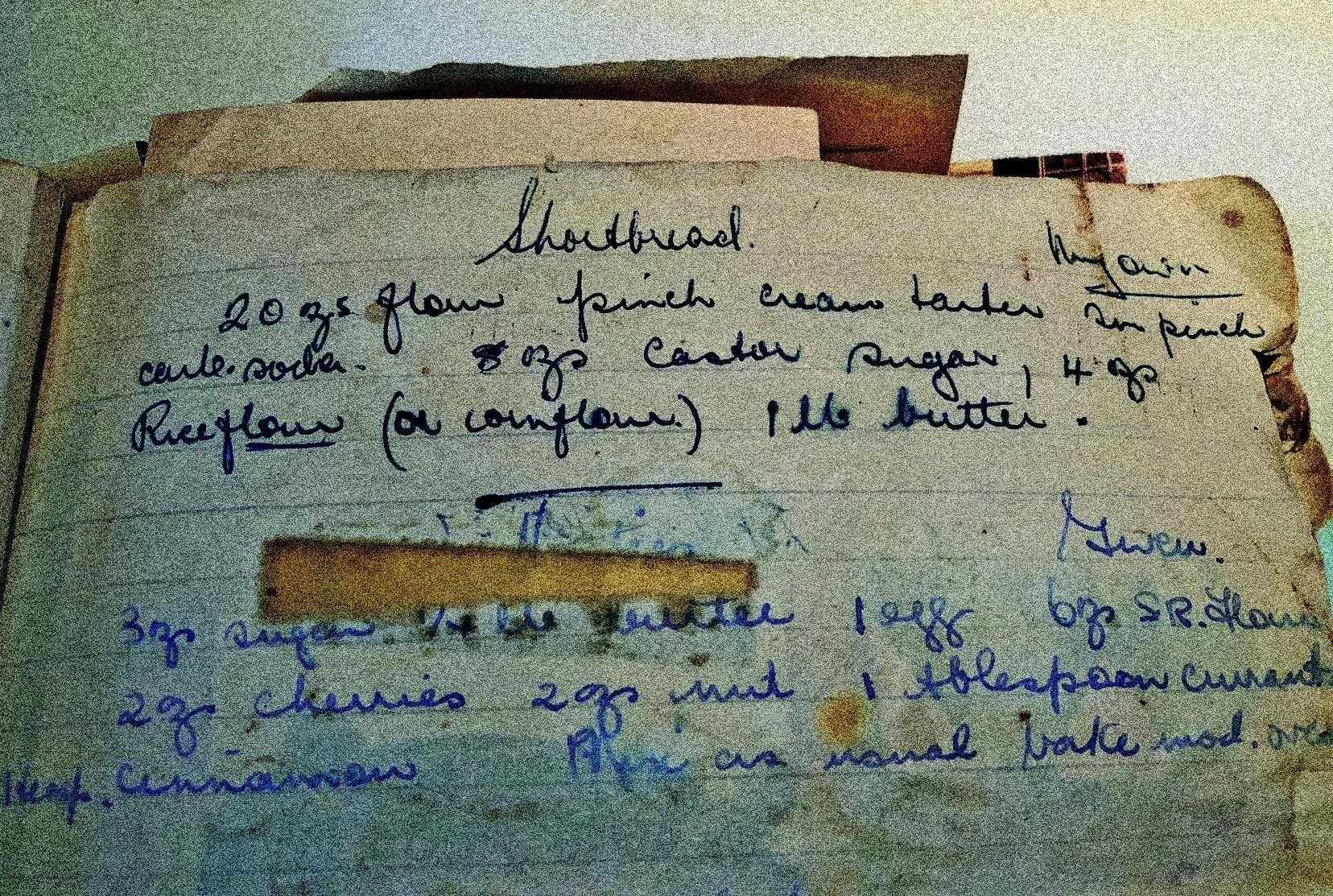
Looking through the book, few jewels jump out at me. I turn pages carefully, noting several shortbread recipes—mum’s, Gwen’s, Mrs Matthews’, and a wartime shortbread made with dripping—then come across one annotated with ‘my own.’ She listed ingredients with imperial measurements but no method. She wouldn’t have needed it.
I did what I was told during our marathon baking sessions but never took notes. When I made the pudding the first Christmas without Issie, I looked through the Christmas section of the book. There were several plum pudding recipes but I had no idea which I’d made with her all those times. I had some recollection of creaming the butter and sugar with bare hands but beyond that I couldn’t recall enough details to recognise what we’d cooked before. Fortunately, I stumbled across a plum pudding recipe with the title, ‘this is my usual recipe.’ Thanks, Issie. There was a list of ingredients followed by the instruction, ‘Mix in the usual way. Boil six hours. Three hours on the day.’ Seriously? Mix in the usual way? I remembered enough to soak the fruit in the alcohol and googled the rest.
Issie was the baking grandmother who stayed up to date with all the modern culinary trends. She would read ‘Epicure’ in The Age and Delicious magazine, cut out recipes and try them out on us. She would cook with new ingredients and the latest fad cuisines before I ever did. I guess it’s not surprising, then, that she had done the same thing as a young woman.
The passing of time and changes in food fads are evident in the book. It’s full of recipes that would have been new and exciting when they first emerged in Australian kitchens. Recipes for brains, stuffed fish pictured surrounded by piped mashed potato and curly parsley. Some old-time desserts have a nostalgic quality to them now, but Issie’s kitchen was too sophisticated for golden syrup dumplings or rice pudding in my childhood. She had recipes for them in her book, though.
There are also five recipes for boiled dressing. Who needs a single recipe for a boiled dressing, let alone five? And what is a boiled dressing? I had to google it. Boiled dressings are similar to a hollandaise sauce, made with eggs and vinegar, flavoured with mustard powder, used to dress salads in the days before vegetable oils were easy to come by.
Issie may have made these dishes once, may have saved the recipes for later and never even given them a go, or perhaps they stayed in her repertoire for years. None of them were in circulation long enough for me to try them.
Recipes from friends collected in the years she and my grandfather spent travelling Europe and America in their campervan also dot the pages of the book. The pancake and waffle recipes have a distinctly American flavour. The curry recipe that looks to be from the 1970s puts her decades ahead of most of her generation when it came to multicultural cooking.
Changes in Australian cultural mores can also be seen. One family favourite is a crumbly chocolate cornflake biscuit, topped with melted chocolate. The recipe for these bickies, originally named ‘Afghan’, was given to Issie by her friend Thea in a time when few White Australians questioned such a name for a brown biscuit. The word Afghans was crossed out decades ago and replaced with ‘Thea’s biscuits.’
‘When my mum died and I packed up the house, I spirited away Issie’s book to my place. I didn’t ask permission or tell anyone I was keeping it.’
I couldn’t find some of my favourites. I miss her crème caramels. Smooth rich vanilla custards that we would un-mould, and a bitter toffee that had dissolved in the fridge would pour out and cover it. She would serve them with toasted almonds and double cream. As a kid, it seemed like she just happened to have a batch of these in the fridge at all times, just in case. As an adult, I wonder if that could possibly be true.
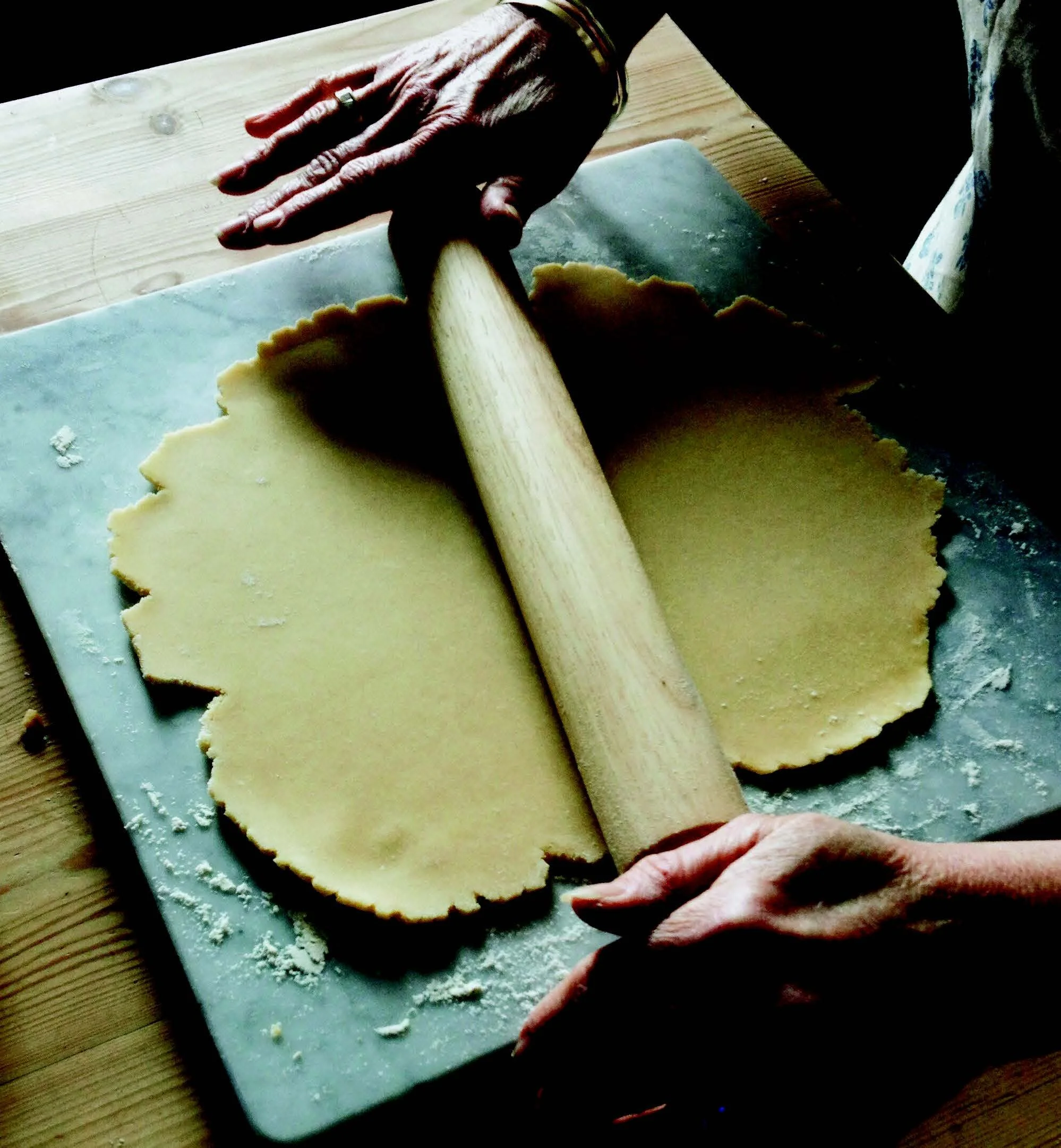
I chose two recipes to make while reading through the book, her shortbread and a chocolate torte. The shortbread was the first recipe we made together each Christmas baking session. I used an electric beater this time and kept at the butter and sugar till it was white, remembering the times when I’d asked, hand covered with sweet fat, ‘is it pale enough yet?’ only to be told to keep beating. I folded in flour and rice flour, kneaded the dough, shaped it into a log and chilled it. I cut and shaped the biscuits, pricked them with a fork and baked them until the bottoms were golden, just as Issie did. I placed half in a glass jar and took the other half to my nephew, as she would have.
The chocolate torte was my brother’s favourite, and my brother may well have been Issie’s favourite. He lived with her for a couple of years in his early twenties after our grandfather died and she made the torte regularly at that time. It has a meringue base combined with biscuit crumbs and nuts or coconut. You end up with a macaroon-like cake—chewy, dense, delicious. Issie would serve it topped with cream, possibly with a flake bar crumbled over it.
I served the torte at a family dinner. It was with the side of the family who decline desserts or ask for only half a piece of cake. Somehow the torte was finished in the one sitting. The shortbreads lasted a bit longer. Each time I took one from the jar and I bit into a buttery, almost crumbly biscuit, I took a moment to remember Issie and everything she taught me.
Finding the gems among the boiled dressings isn’t easy. On face-value the book is not the treasure I had expected but poring through the pages of Issie’s book, reading neatly handwritten recipes, I’m back at her kitchen bench. I’m opening the Christmas hamper. I’m sticking my bare hand into a block of butter. I smell the smells and taste the tastes. I’m with my beautiful grandmother. I wouldn’t dream of parting with it.
COMFORT FOODS
DOSA – ANJALI
Fermented rice and dhal crepes
Anjali’s Appachi (paternal grandmother) from Malaysia stands at the stove cooking dosa after dosa for the whole family. She makes them soft and fluffy and serves them with curry or chutney. But Anjali prefers them plain: ‘eating it at Appachi’s place — it’s nostalgic and I love it.’
PAN ROLLS – CONOR
Served as an appetiser, pan rolls are spiced beef or potato inside a crepe, rolled like a burrito, then crumbed, deep fried and served with chilli sauce
Conor’s Sri Lankan Nana, Gail, makes pan rolls for any family celebration. The effort Gail puts into mak- ing them is a demonstration of her devotion to her family.
ZEPPOLI – ANGELINA
Angelina’s mum cooked zeppoli during school holidays, Easter and Christmas
‘All the kids, including cousins, would gather around the kitchen table and mum would make this amaz- ing sticky dough and we would all watch it rise. I found a similar recipe … but as you can appreciate, Mum did it without measurements, just by feel. Mum would also make a round variety where she would add anchovies — which were fantastic. We would all eat them straight out of the deep fryer and burn our mouths because we could not wait. It was always a competition to see who would get the first!’
SHEPHERD’S PIE – SHARON
Classic English pie that uses leftover mince and vegetables
The family recipe ‘is not really one that’s written down, it’s more a set of principles that guide what you do.’ Leftover roast lamb is minced with onion and mixed with minced celery, Worcestershire sauce and chutney or homemade tomato sauce. Pop in a baking dish and top with mashed potatoes, melted butter and cheese. Sharon calls it ‘serious comfort food’ that reminds her of her grandma from the Adelaide Hills. ‘She had a wood stove so it was always warm, as was she.’
FRIKKADELS – COLLEEN
Meat patties or meatballs, there are many recipe variations using different herbs and spices
Colleen and her family emigrated from South Africa when she was three years old. ‘Frikkadels made me feel like I was eating something special. It was the 1970’s and Australia wasn’t culturally or racially di- verse. Describing our Frikkadels as rissoles or hamburgers to the neighbourhood kids somehow made me feel more included and less of an outsider with my accent and darker coloured skin. Now when I eat them, I enjoy the flavours. I feel good and comforted — like having a warm hug from my mum.’