
THE JAPANESE ART OF TEA CEREMONY
WORDS BY VICTORIA TREMBATH
Matcha may be all the rage these days, but it comes with a rich history. From its roots in Zen Buddhism, Japanese tea ceremony has developed into a ritualistic art of precision and sharing that has spread across the world.
Turning off my alarm and rolling out of bed, I head to the kitchen to start the most important item of my morning ritual—my cup of tea. Each step of the brewing is important, from the temperature of the water down to the cup I use. My morning tea is usually genmaicha, a Japanese green tea that contains roasted grains of rice. In the cold Melbourne mornings, the warmth of the cup energises my cold hands and as I slowly drink my tea, I know I’m ready to start my day.
My conversion to tea happened in Japan. At the end of Year Ten I was lucky enough to go on exchange to our sister school in Kagoshima prefecture. During my time there they introduced us to the traditional art of Japanese tea ceremony. The school had a tea ceremony club and we were able to attend one of the club’s lessons. Dressed up in kimonos we were shown the art and etiquette of tea ceremony. The hostess was incredibly graceful; each step in the tea making process required utter precision to ensure that the final cup was perfect for the drinker. The tea itself was a lovely combination of sweetness and bitterness that I had not been expecting, especially given green tea’s bitter reputation.
Japan’s tea ceremony originated from a Zen Buddhist ritual, where monks would drink tea to keep them awake during long meditation sessions. In the thirteenth and fourteenth centuries drinking matcha became a part of wild social gatherings where rare imported Chinese art would be displayed. Around the fifteenth century the ritual of tea drinking was regarded as a path to salvation, with the purpose of the practice to empty one’s mind in order to become enlightened.
Tea ceremony evolved again in the sixteenth century thanks to Sen no Rikyu, an aesthete of military dictator Toyotomi Hideyoshi’s court. He decreed that there were four guiding principles for a tea ceremony: harmony between guest and the implements used, respect for participants and utensils, cleanliness and tranquillity. He also instilled the concept of ichi-go ichi-e, highlighting that no two tea ceremonies would be the same. Unlike in previous centuries, the tea ceremony became a transformative art that allowed the host to demonstrate, through the preparation of their house, meal and tea, an appreciation of their relationship with the guest.
In 2014 I had the opportunity to live and work in Japan and during my time there I attended regular tea ceremony lessons with an American friend. I learned how involved each step in the tea making process was and also discovered other aspects integral to the ceremony, such as the room setup and how that changed depending on the season. During spring and summer, a chagama, a type of cast iron kettle, is used for heating the water. In autumn and winter a ro, a small sunken hearth, is used for heating water. Setting up the ro requires that the charcoal used for the fire be placed in the hearth with a pair of large metal chopsticks. The biggest challenge was ensuring that the charcoal didn’t drop onto the floor—metal chopsticks and charcoal make for a very slippery situation.
During the time I was learning tea ceremony I discovered that in comparison to its early roots, the contemporary tea ceremony is a highly structured affair. Only certain guests are allowed to speak with the Teishu, the person who makes the tea, and the topics of conversation centre around the tea utensils. Before drinking the prepared tea, guests are served a wagashi, a Japanese sweet, to help combat the bitterness of the tea. Guests receiving the tea also have to turn the chawan, the tea bowl that they drink from, in a particular way to show off the bowl’s pattern. The chawan, chashaku, the tea spoon used to scoop the match powder, and the natsume, the tea container, are viewed by the guests towards the end of the ceremony to appreciate their craftsmanship and decorative detail. In the spring and summer, the chawan is usually shallow with floral decorative patterns, while chawans used in winter are deep with dark colours and simpler patterns. The most prized chawans are ones made by hand with irregularities or imperfections that developed while they were being made.
Unlike a tea ceremony event, my lessons were more relaxed and a casual affair. Learning a craft that was so particular was challenging for everyone and the Japanese women were always happy to help me in any way they could. They all knew the best places around to buy tea and showed me the finer points of tea making. Even though the event was highly structured, tea ceremony was a ritual that bought us all together.
Returning to Melbourne I found myself treating my cup of tea as a practice to savour. I focused on learning the brew times and temperature of water needed for different teas and began having tea parties with friends.
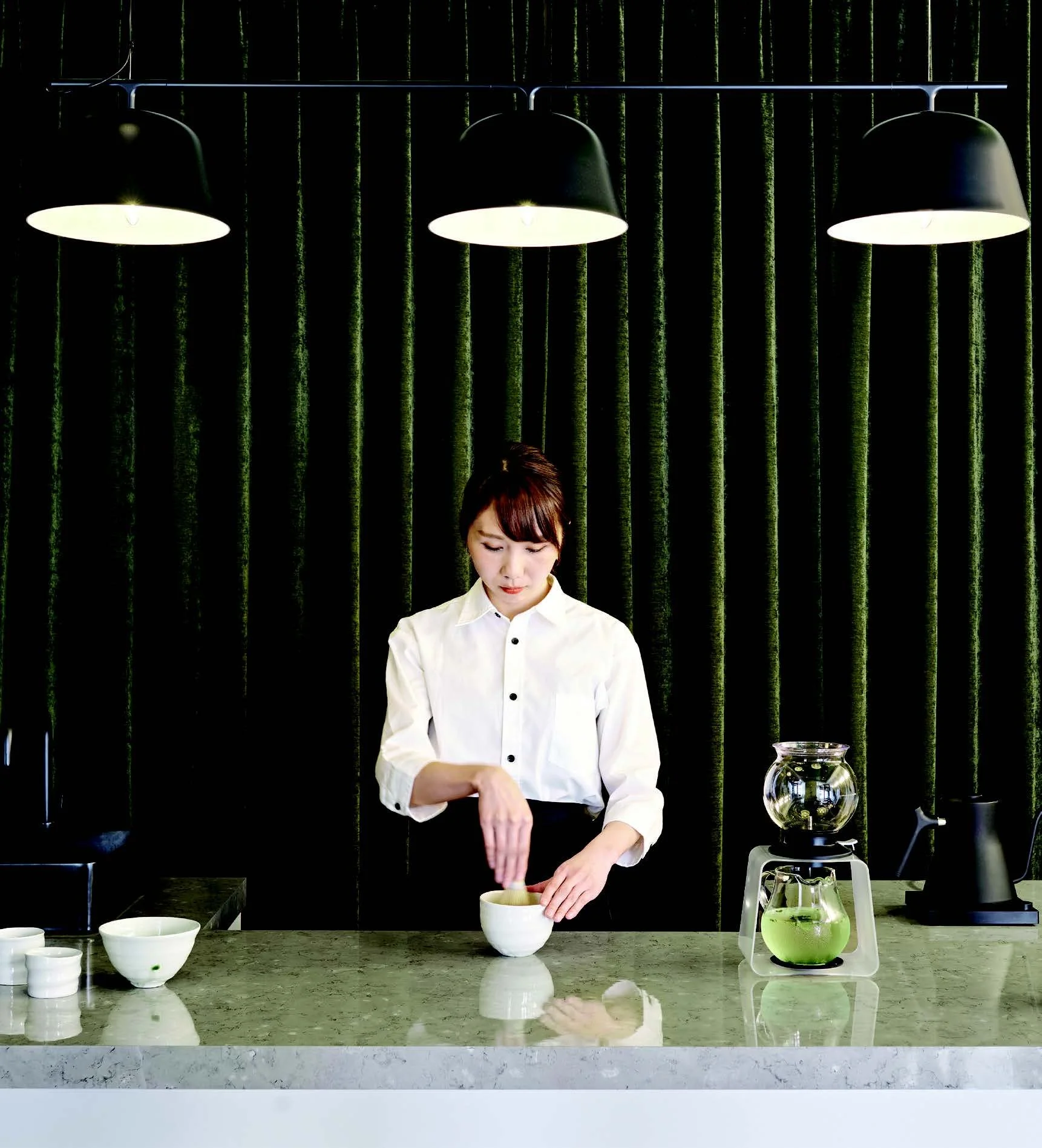
Recently, I have discovered a new favourite tea store that combines my love of Japanese culture with my love of tea. Along Johnston Street in Collingwood a speciality Japanese tea studio, Harvest Index, opened in March. The studio designers, Benjamin Wright and Lachlan Sinclair, were inspired by the Japanese concept yuttari — the feeling of relaxation. The studio is quite small but the mixture of whites, forest greens and dark-coloured woods creates a calming atmosphere. ‘Our studio is roughly forty square metres, about the same size as a typical Japanese tea house,’ Benjamin tells me. ‘It’s exactly what we needed to recreate the yuttari feeling.’
The central focus of the store is the tea experience. The small seated tasting area allows for up to four people to sit and taste Harvest Index’s 100% certified organic tea from the Uji region in Kyoto. ‘In our tea ceremonies, we seek to understand our guests’ relationship with tea, what they like and what feeling they are looking for tea to evoke,’ Benjamin explains. The studio offers six different types of mostly green tea in various grades and customers are able to try as many of the different teas as they like during their thirty-minute session. Benjamin is happy to delve into the details: ‘each variety of Japanese tea has its own unique relationship between caffeine and two key ingredients, L-theanine and catechin. Varieties such as matcha, have potent L-theanine and caffeine, and the resulting combination promotes an alert, yet calm feeling. Alternatively, catechin powered hojicha gives drinks a therapeutic, low caffeine brew which is perfect for the evenings.’
Rie Ohnuki, Harvest Index’s tea specialist from Japan and the store co-manager, is a wonderful host to my friend and I; she is bright and easy to converse with. ‘Our mission is to teach our audience that Japanese tea is as environmental as it is sensory,’ Rie tell us. ‘The ritual of brewing tea is a special meditation which relieves stress and promotes piece of mind.’ One of Rie’s roles at Harvest Index is to help understand guests’ needs and particularities and so she suggests different teas to try depending on what tea you usually drink. During my session with her I was able to try wakocha, a Japanese black tea. I was intrigued as I had never heard of this before, but also a bit nervous to try it as I usually don’t like black tea. However, I was taken aback with how pleasing the bitterness and sweetness was, and Rie was kind enough to allow me to take a sample of it home.
Rie’s knowledge about how each tea is harvested and processed is informative and fascinating. Explaining the purpose of both the tea and the ceremony, she explains that they are ‘renowned for health benefits including mental clarity, healthy digestion and the ease of anxiety.
‘Sen no Rikyu decreed that there were four guiding principles for a tea ceremony: harmony between guest and implements, respect for participants and utensils, cleanliness and tranquillity.’
These remedial properties paired with the ritual of brewing make for an experience unlike any other.’ During the session, Rie demonstrates brewing techniques unique to each tea variety and grade and turns it into an exact science. Each tea is weighed carefully before brewing to ensure that the correct amount is used, and the cups and teapot are heated with hot water before beginning the brewing process to ensure that the tea is served at the correct temperature.
During our session I asked her what her favourite tea was from Harvest Index: ‘My favourite tea is M02 (Matcha 02), it has a satisfying sweetness and is an essential part of my morning routine. I like to prepare my matcha in a quiet environment, reserve enough time to brew the tea and relax and enjoy the taste.’ After hearing that, my friend and I had to try it and agreed with her completely. The tea had a satisfying sweet taste with just a hint of bitterness.
My time at Harvest Index really reminded me that tea is the perfect way to relax and enjoy a small moment of the day, whether it is by myself or with friends. Lachlan Sinclair, one of the store’s designers, sums up what I feel perfectly. ‘There’s something special about the ritual of tea that is so uniquely therapeutic. Yes, it takes a few precious minutes but it’s a way of incorporating meditation into daily life, while experiencing the changing flavours of tea as you brew throughout the day.’
JAPANESE TEA (お茶) GUIDE
GENMAICHA
Genmaicha is a blend of green tea and roasted brown rice grains, which adds a slight popcorn flavour to the tea. When brewed, the tea is a golden-green colour. A great everyday tea.
HOUJICHA
Known for its distinctive reddish-brown colouring, Houjicha is green tea that has been roasted over a high heat. Roasting the tea creates a savoury, nutty flavour and removes any bitterness. This tea is also low in caffeine, making it a perfect tea for those who are caffeine-sensitive.
MATCHA
Matcha is a finely-ground green tea powder, made from the finest green tea leaves. Unlike other teas, it is lightly whisked in hot water to create a frothy drink. Highly regarded for its health benefits.
MUGICHA
Mugicha is a savoury roasted barley tea. Served cold, it is a staple drink in the warmer weather and a key to surviving the hot and humid Japanese summers. The tea has a strong toasted-grain flavour and is caffeine free.
SENCHA
Sencha is the most common type of Japanese green tea. It is noted for its mild astringency and bright green colour. Sencha is Japan’s most popular tea — it is the one most likely to be served to guests at someone’s home.
