
Sunshine and lollipops
Everyone has a story to tell. Here, local lollipop man Gonzalo shares some of his.
Words by Ruby Walker
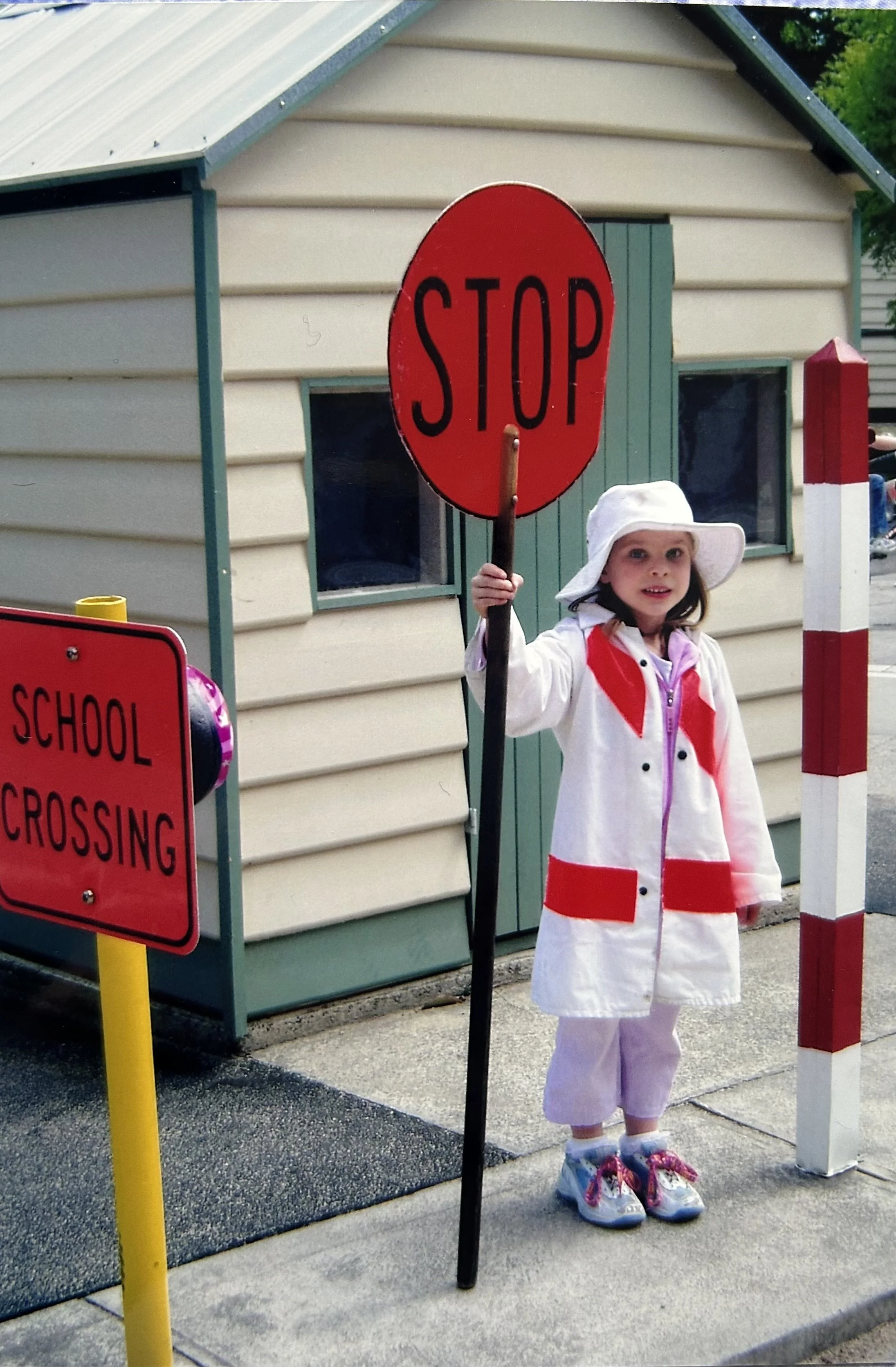
Ruby Walker as a child holding a stop sign and dressing up as a crossing guard
The traffic island is bordered by an unwavering stream of cars. There’s constant movement. Cars, cyclists, motorbikes; the wind; pedestrians wheeling prams full of children with chubby limbs. At 8 am, an athletic looking man strides over, lifting his stop sign up with confidence. He wears a pair of wrap-around sunglasses so I’m unclear of his age. He shakes my hand, his palm soft. ‘Gonzalo,’ he offers. As well as his name, Gonzalo shares his pliant, effortless smile.
With our trusted tools—a fluorescent broad-rim hat, bright yellow zip-through jacket, hand-held whistle and a stop-sign in the shape of a giant lollipop—we command the traffic. In our uniforms, there’s no question of our purpose. Gonzalo and I will be colleagues for the week, the traffic island our office.
Gonzalo has been working as a crossing supervisor for seven years. A significant amount of time, though not when compared to a woman from his team, who has just made it to 50 years in the same role.
‘Do you speak Spanish?’ Gonzalo asks me, his vowels lilting with his accent.
‘I wish,’ I respond.
A family walks up to the crossing, two boys and a father.
‘Hola, cómo estás?’ Gonzalo asks, beaming at the three of them.
The boys answer back and they all have a conversation in fluent Spanish.
‘They are my friends. They remember me. The little boy, he made a model of this crossing for a school project, with tiny figures. The figures had name tags.’
‘Was it you? Your name?’
‘Yes.’ Gonzalo is noticeably chuffed, the muscles from his cheeks pushing against his glasses.
The traffic rolls past with gusto and Gonzalo raises his voice. The fence that surrounds the traffic island is broken, smashed in.
‘Looks like an accident?’
‘Yes, two accidents, but not when we were standing here, they happened at night.’ Gonzalo hangs his head regrettably, his tone dropping as he considers the potential impact the out-of-control cars could have had.
Gonzalo shifts the lollipop pole from under his armpit to right in front of him, extending the height of the sign well above his head so people in their cars can see the black letters spelling ‘STOP’. When it’s safe, he bounds onto the road, his nylon hiking pants making swishing noises as he walks back and forth. He appears in harmony with the endless traffic, his whistle blowing in an enthusiastic symphony.
On Tuesday morning, Gonzalo reveals he’s from Peru. ‘When I learnt to read I did it by candlelight. They [guerilla groups] blew up the electricity plants all the time, the city was dark.’
Home was never safe and he had a childhood of insecurity. Still, he describes it with love: the mountainous highlands, lush beaches and diverse city of Lima. None of Gonzalo’s family are in Peru. Instead, they’re in the USA and Canada. They had little choice but to leave.
A young girl with thick glasses and two plaits gets out of a sedan near my side of the crossing, her mum pressing the buttons of her jacket together before pushing the girl towards the white line. After she crosses my side of the road, Gonzalo greets her.
‘Hello miss!’ He opens his arm in the direction of the school like he’s conducting a hidden orchestra. ‘Have a beautiful day.’
“When I learnt to read I did it by candlelight. They [guerilla groups] blew up the electricity plants all the time, the city was dark.”
Gonzalo possesses a youthfulness unique for his age. His experiences shared with me of growing up in Peru in the 1980s are lively and animated. He greets everyone, child and adult alike, with ‘good afternoon, sir’ and ‘good afternoon, miss’.
‘Have you always known English?’
‘I was about eight when I learnt by watching American TV with subtitles. I’m learning French and Italian now.’
Distracted by another school-bound child, Gonzalo speed-walks over the line and brandishes his stop sign, the whistle already held between his teeth. His English is inflected by his enthusiasm for his job and life in Australia. He speaks in a way that respects language, pronouncing each syllable.
Amid the beat of our Thursday morning, Gonzalo reveals that he is a math tutor. In his spare time, he’s also a dog walker. His days are full.
On Friday, Gonzalo tells me that before coming to Australia he was a minor celebrity. Gonzalo was an executive banker, in charge of high-profile accounts for Citibank. He made his mark devising a strategy that has since been adopted by other banks in other countries. After this success, he was offered a permanent position in New York City with a significant pay rise. Gonzalo declined the promotion, favouring a self-directed move to Australia instead.
He is a qualified engineer, having studied back in Peru and used his skills in the banking world. On what it was like for him as a university student in Lima, Gonzalo said:
‘One day over class break I had nothing to do, so I hopped on a bus to go see the turtles. The turtles only nest in this one spot on the coast three hours away. I went with no accommodation, no plans. The rooms were all booked and I had nowhere to sleep, so the hotel put me in the utility cupboard for the night with one pillow and no blanket. That night, it was a full moon. Usually this means the turtles don’t come out, but they did. It was magical.’
The 10 am traffic is docile, cuing the end of our week together. Before offering me a handshake goodbye, Gonzalo takes off his glasses. It’s the first time I’ve seen his whole face. His eyes are blue and crisp, the skin around them speckled by tiny wrinkles. He rubs a line of sweat off his nose and takes off his broad-rim hat. His now familiar smile curls the sides of his mouth, pulling at the deeper lines of skin visible on his neck and behind his ears.
‘Good luck,’ Gonzalo says, his hand firm, before lifting his glasses back to their spot over his face.