
CULTURE WITH A SIDE OF INJERA:
SABA’S ETHIOPIAN RESTAURANT
WORDS BY CARLY GODDEN
Saba Alemayoh, the proprietor of Saba’s Ethiopian Restaurant, chats about the Ethiopian way of cooking and the story behind their favourite fermented flatbread, injera.
An interest in cooking isn’t what started Saba Alemayoh off in the restaurant business at all. ‘I had an interest in sharing culture,’ she explains. ‘It was very accidental and we just fell into it. I took people around to my mum’s house for dinner all the time and they really enjoyed the meals.’ Saba and her mother started off with catering gigs and markets, eventually opening Saba’s Ethiopian Restaurant in Fitzroy in 2015.
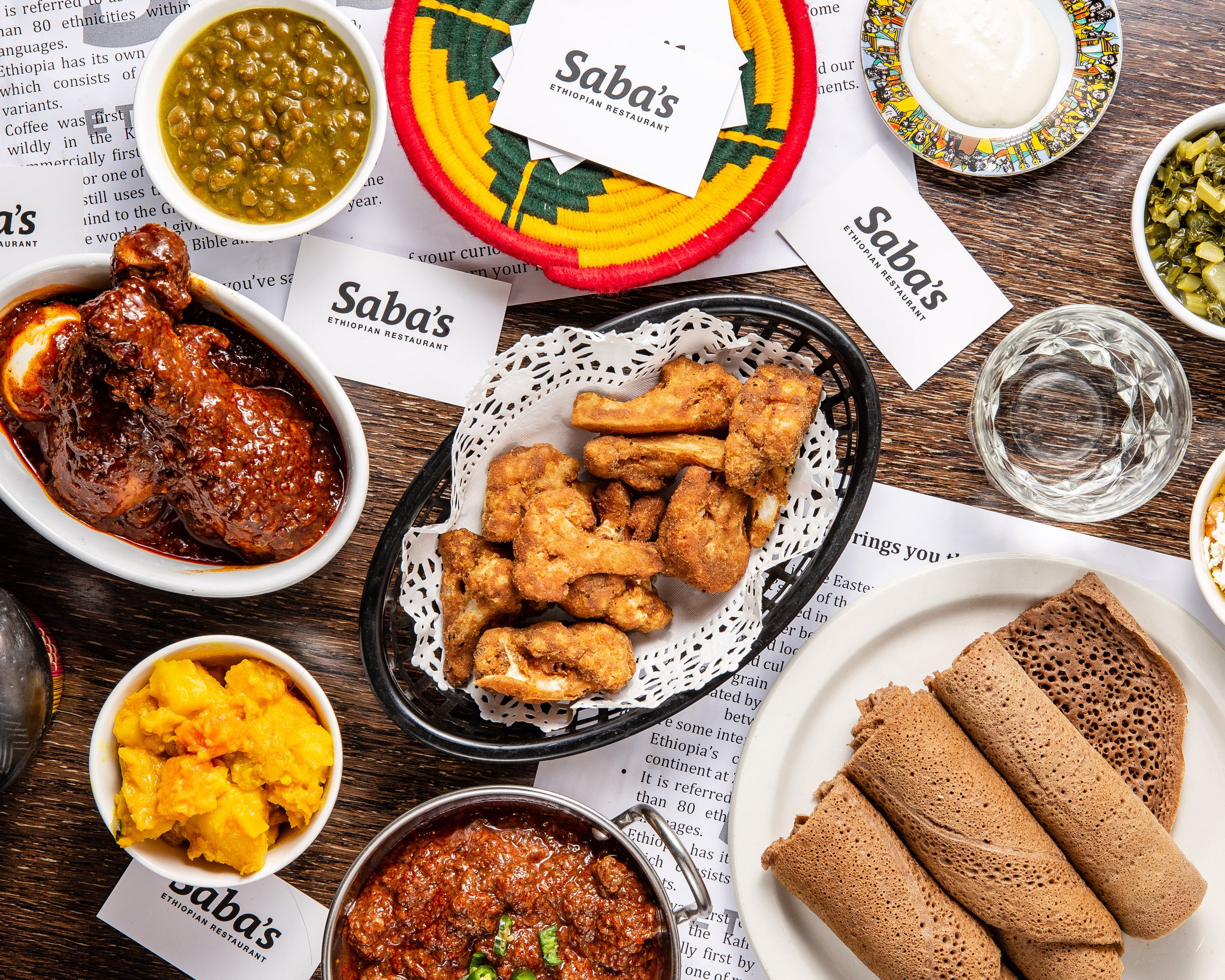
Most dishes are served on injera, a fermented bread that is a mainstay of Ethiopian cuisine and which also serves as cutlery. The spongey texture of the bread is perfect for soaking up stews—like their alicha birsen, consisting of yellow split peas cooked in a turmeric paste, or biray kulwa, a diced beef dish cooked with spices (including berbere) and tesmi (spice butter). Happily, for plant-based eaters, legumes are also a consistent feature of Saba’s menu. Coeliacs are equally well-catered for as everything served up is gluten-free.
‘Their injera is prepared by hand, kneading the dough and using the senses to judge when it has properly fermented.’
Until recently, practically all of the dishes served in the restaurant were cooked by feel rather than from a recipe. The dishes were devised by Saba’s mother, who learnt to cook by instinct using traditional techniques passed down within her Ethiopian family. Their injera is prepared by hand, kneading the dough and using the senses to judge when it has properly fermented. Does it look right? Does it smell right? Feel right? ‘Sometimes my mother might look at the injera and say “nah, nah, nah,”’ explains Saba. ‘Because of things like the ambient temperature of the room, it might not be ready yet.’ This knowledge comes largely from experience and is part of the non-prescriptive approach that defines Ethiopian cooking. Saba makes no apologies for keeping the recipes authentic. She points out that modifying dishes just to please Western palates would defeat the very reason she runs her restaurant, which is about turning a dining experience into a cultural experience.
Saba’s injera is made from teff flour. In Ethiopia, teff is sold everywhere in red, brown, and ivory varieties. Red is the cheapest and is usually bought by poor families in regional areas, alongside brown, while affluent Ethiopians purchase ivory teff. One of the world’s smallest grains, teff is known to be a good source of essential fatty acids, fibre and minerals, especially calcium.
Up until 2015, it was illegal to export teff outside of Ethiopia because authorities were concerned that enough should be available for the domestic population. Those with Ethiopian heritage living in Australia substituted teff with self-raising flour to make injera and achieved similar results. Luckily teff is now grown locally and Saba sources her supply from Victoria’s western districts. As a drought-tolerant crop needing little water, it is well suited to the Australian climate, although it is not grown in large quantities. Few Melburnians know how to cook with teff and it is often sold as a high-end product in health food shops. With teff priced at around $8/k, many local Ethiopian families have stuck to using self- raising flour.
Injera isn’t the only fermented food common in Ethiopian cuisine. At Saba’s Ethiopian Restaurant they serve up a fermented honey drink, described on the menu as honey wine. Saba explains that while in Melbourne it’s convenient to classify it that way, it’s not really thought of as a wine in Ethiopia. ‘Ethiopian culture doesn’t really think about itself relative to the West.’ In Ethiopia the mead-like drink is brewed at home, especially during celebratory times, or it can be purchased in Ethiopia’s Tej houses, where it usually comes served in a long-necked flask known as a berele.
In ordinary circumstances, Saba practically lives at the restaurant, overseeing a consistently busy turnout of customers. With the restrictions placed on hospitality businesses due to COVID-19 at the time of writing, Saba’s Ethiopian Restaurant is only running a takeaway service. Saba reflects that while it’s a hard time for many, consumers perhaps have more power than they realise. ‘Our lives are usually so jam-packed,’ says Saba, ‘that we don’t think about where we are picking up vegetables, who we are buying our food from.’ She believes that individuals can shape the kind of society they want to build after the pandemic and should consider how they spend every hard-earned cent.
In the five years since it was established, Saba’s restaurant has become a fixture on thriving Brunswick Street. Those who eat there can always look forward to injera, a fixture on their menu and a foundation of Ethiopia’s rich and community-centred cooking tradition.