
AT THE HEART OF KOREAN FOOD
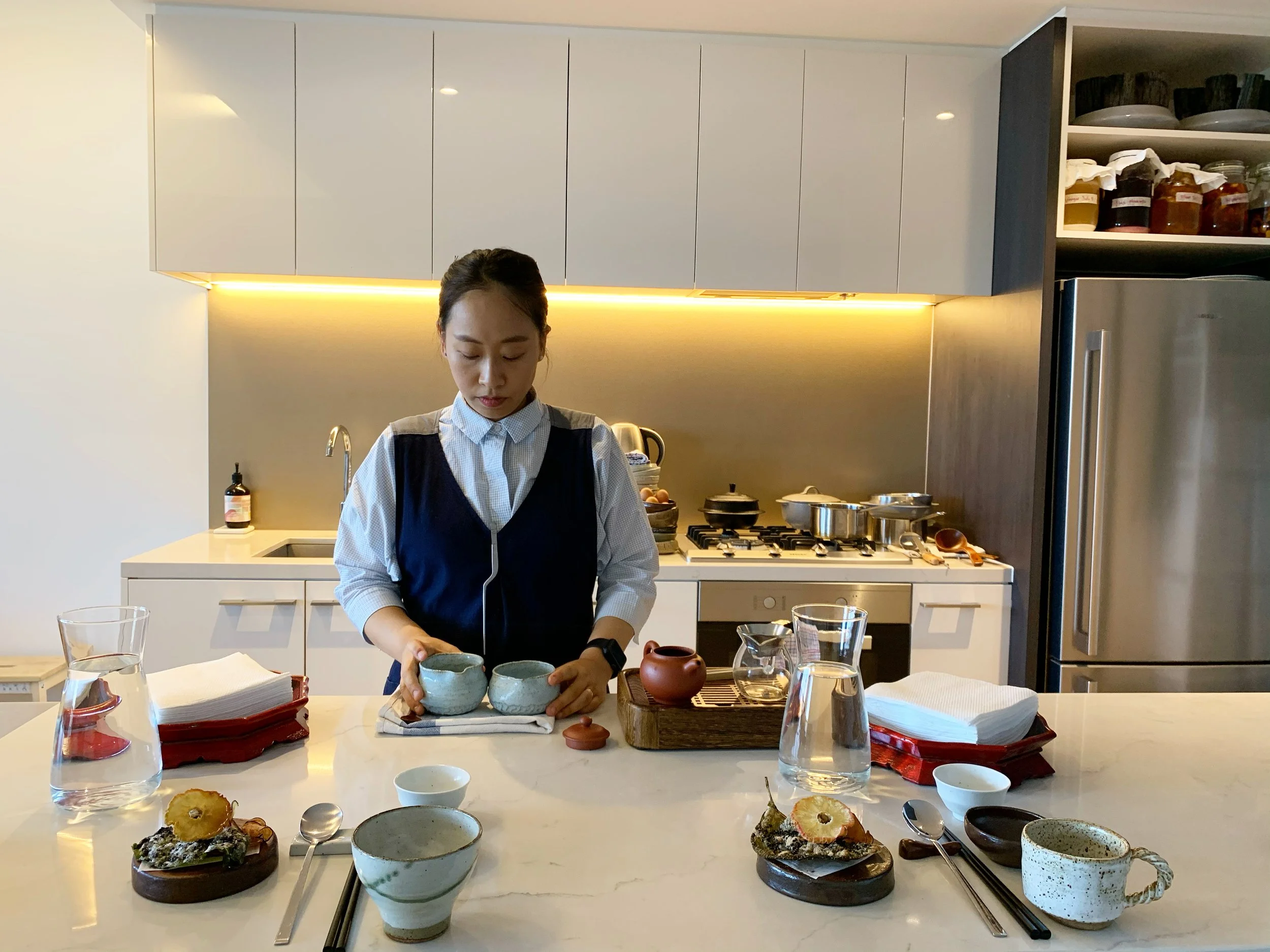
EMILY CECCHETTO CHATS WITH JUNGEUN CHAE
Jungeun Chae is a Korean-born chef who now lives and works in Brunswick. She began sharing her knowledge of Korean food on a YouTube channel last year and now has her own studio, where she runs cooking classes and dining experiences. Here, Forkful speaks with Chae about her love of the fermentation process and how it led her to teaching in Melbourne.
Emily: Tell us a bit about yourself, Chae.
Chae: Since I was young, I have always been a picky eater with a keen sense of taste—I had a clear idea of what kind of food I liked. I was not very obsessed with food—I guess that’s why I enjoy cooking for others, as opposed to cooking for myself. I have a sense of satisfaction when I see people enjoy my food.
To achieve my goal, I worked as a chef for fourteen years, gaining experience by working at various restaurants. Now I [have] managed to open my small— but productive—studio where I can cook the food I want.
Emily: Tell us about your business: Joobang.
Chae: I was no longer able to continue to work for [a] restaurant after I was in a car accident. While I took some time off to recover from my injury at home, I started a YouTube channel as a hobby to record my recipes and experiments with fermentation. Then it morphed into [an] offline business where I interact with my customers and teach fermentation.
Korean food is not widely known in Australia. I would like to help people discover Korean food [beyond] just kimchi or bulgogi—this is what Joobang is about.
Emily: How did you become interested in fermentation?
Chae: Korean food is based on fermentation. Naturally, I grew up eating fermented food. I learned about fermentation, and healthy eating, from my grandmother and mother. That’s why I have never been a fan of strongly seasoned foods that have sweet, hot and salty tastes. Fermentation is the natural result of a perfect balance between temperature, humidity and ventilation. It’s important to achieve that balance.
Emily: Is fermentation involved in all Korean food and culture? What are some the traditional Korean ferments that you teach?
Chae: It wouldn’t be an overstatement to say Korean food starts and finishes with fermentation. In Korea, winter (December to February) is the busiest season for fermentation. My family in Korea prepare and stock up a year’s worth of kimchi, gochujang (fermented red chili paste) and enzymes during those months! Then they preserve this for at least one year of the aging process. Through Joobang, I teach all kinds of Korean fermented food including bean paste, chilli paste, rice syrup and rice wine.
‘It wouldn’t be an overstatement to say Korean food starts and finishes with fermentation.’
Emily: You use some of your mum’s recipes for different ferments. Is it important to you to keep teaching your family’s recipes and passing them on?
Chae: As families become smaller and people prefer the city life, people don’t like to ferment their own food. I guess my parents’ generation is probably the last generation where they all ferment their own food; my friends don’t make their own kimchi. That’s why I’m very grateful that my mum taught me all the tips for fermentation. I feel very fortunate to have someone to ask for help when the fermentation process doesn’t work. I would like to be that ‘someone’ here, through Joobang, so I can share my tips with like-minded people.
Emily: What do you love about fermentation?
Chae: I love fermentation because it is nature itself. I believe fermented food makes you healthy not only physically, but also mentally. My favourite ferment to teach is Korean traditional rice wine.
Emily: I noticed that you go out and pick a lot of the food you use to cook with, or buy fresh produce. Why is that important to you?
Chae: My philosophy is cooking in the simplest way possible, but I also focus on using the most fresh, seasonal ingredients.
Emily: You describe the kind of food you teach as ‘slow Korean food inspired by nature’. What does ‘slow food’ mean?
Chae: Fermentation is the process of waiting and patience. During fermentation, there is not much I need to do. I just let it run its course.
Emily: A lot of people are interested in ‘slow food’ and are starting to bake their own sourdough bread, pickle their own vegetables and make ferments. Why do you think it’s become so much more popular?
Chae: The world is so fast-growing, and it became so easy to get your hands on food. But on the contrary, it became very difficult to find real food. I believe people these days are looking for slow food because they like how it is cooked in the traditional way.
Emily: Melbourne prides itself on its food culture. Do you think fermentation could become a bigger part of that? Is Melbourne’s fermentation community growing?
Chae: I can definitely see Melbourne’s fermentation community growing much bigger than it is now. Melburnians are not afraid to try new things and they like to explore. I’m sure they will be open-minded about fermentation as well.
To learn more about Joobang by CHAE 蔡, or to see some great Korean food, visit:
Facebook: Joobang by CHAE 蔡 Instagram: @chae_melbourne YouTube: JOOBANG