
THE SPICE RACK MANIFESTO
WORDS BY JAHAN REZAKHANLOU
Opinions about sharehouse kitchen protocols are about as divisive as they come, but Jahan Rezakhanlou is here to convince us that there is one rule that belongs in all kitchens: the communal spice rack.
A sharehouse can be a platform for all sorts of culinary experimentation and a forum for cross-cultural learning. Is the spaghetti al dente if it sticks to the wall? What is the golden ratio of rice to curry? How to make the perfect Indomie? These are all questions best answered in a sharehouse kitchen on group cooking nights dedicated to a communal process as much as the final result.
But then reality hits … and we have to take into consideration that typically in a sharehouse, all members are leading different lives each with their own schedules, especially as (inshallah) the era of lockdowns seems to be behind us. This makes a lot of cooking rushed and individualistic, so a dish is thrown together just to fill you up before venturing out, rather than to explore and create during the cooking process. Nights of collaborative experimentation are not as regular an occurrence as one would like when you’re just in the kitchen to heat up leftovers or assemble a quick sandwich. The fridge becomes a balkanised set of fiercely defended private domains.
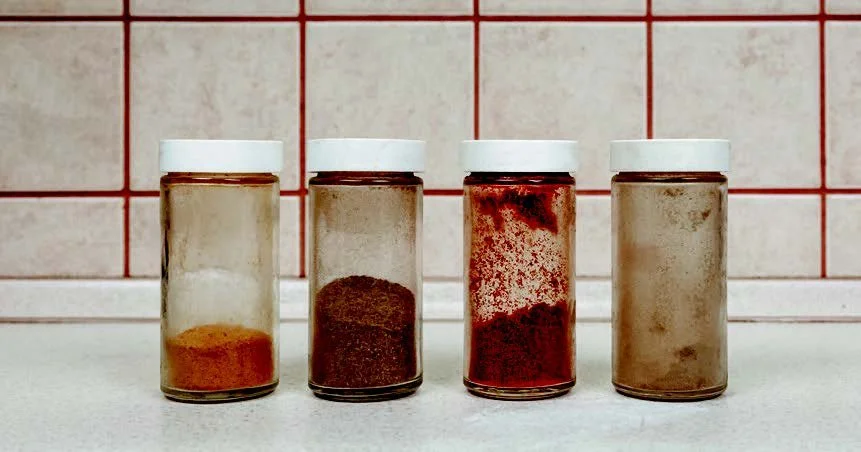
This is where, as a child of the former Silk Road, I prescribe to sharehouses across Melbourne/Naarm a kitchen staple—fresh out of the Samarqand bazaar: a living, collaborative spice rack. Now I’m not talking about the small premade Kmart ones or a shelf space comprising of a collection of the little glass containers from Woolworths sitting inert only to be packed up, untouched, for the move to the next sharehouse. Instead, I encourage sharehouses to create as large a space as you can spare in the kitchen for this spice rack, which is then populated as a collective endeavour, so that in plain sight there will always be a colourful array of jars and containers—some routine staples, some ‘exotic’ discoveries—inviting exploration along the laneways of a virtual bazaar, offering a subconscious reminder that even in a rush one can experiment and transform each meal so as to ensure it tastes unique for the day and the mood of the person cooking it.
Even if it’s a simple dish like a stir-fry based on random discoveries in the vegetable drawer, a Marion’s Kitchen curry pack or the dreaded pot noodles, a fully equipped spice rack can really elevate and help you customise each cooking experience. Want to add a ‘fruitier’ heat to your dish? Use the pul biber (Aleppo pepper). Want to add an extra warm crunch just for the sake of it? Try some coriander seeds. How about a sustained, citrusy note for a kebab? Take lemon myrtle, from the Indigenous end of the rack. It’s all there, at hand, beckoning you to try fresh culinary ventures.
For this to work, creating and supplying this kitchen staple must be a continuous collaboration between all housemates. Each person can supply their own preferences and make their distinct imprint on the kitchen, adapted for their own cooking styles and traditions, yet available for all others to sample in their own cuisine. Crossroads on the Silk Road! For instance, as an Iranian, I supply ingredients like saffron, sumac and fenugreek which I tend to use more than anyone else, while my Indonesian housemates provide nutmeg, cassia and kaffir lime leaves, which they use more than I do. And there’s common ground for the most frequently used spices such as turmeric, cumin seeds and cinnamon. Whenever I try using cassia in my dishes, it feels like a collaboration with my housemates, even if they are not actually present when I’m hastily making a twenty- minute meal before heading to work.
Aesthetics are also important. The kitchen should be a clean and attractive space, pleasant to be in, enhancing the experience of cooking and making it an agreeable meeting place. So, of course, with this spice rack comes a wide range of colours and textures that instantly give the kitchen more personality, turning the space into a sort of functional and interactive art piece. Using a variety of jars and containers also helps, with large, generous jars for the most commonly used spices, and a range of smaller ones for those used more rarely. The uniformity of identical Woolworths containers really creeps me out as it feels like a tacky kind of gentrification of a space that shouldn’t look so conformist, but rather be a celebration of diversity.
When starting this ‘project’ with my housemates (in the midst of lockdown, of course), I found that it did really help me explore new foods and cultures. I started properly appreciating how the whole could be greater than the sum of its parts, as new combinations of spices gave a lift or a new twist to even well-known staple dishes. Anyone can go and eat out at a hundred different ‘ethnic’ restaurants across ‘multicultural’ Melbourne/ Naarm, but the truth of the matter is that the taste is only half the story. The creation process is just as much of an element to a region’s food culture, and having the power at your fingertips really encourages you to explore it, even if it’s a hasty improvisation.
Staying at home can still be a journey. As a kind of culinary conversation, it can enrich sharehouse life and bring fresh pleasure to the mundane business of refuelling yourself, even on the most stressful days.
