
Interview with a Housemate
Milla Rovere started out directing cows in a field. Now she’s directing people in a field.
Words by Pearl Salmon-Watson
Photos by Sylvie Grace Allen
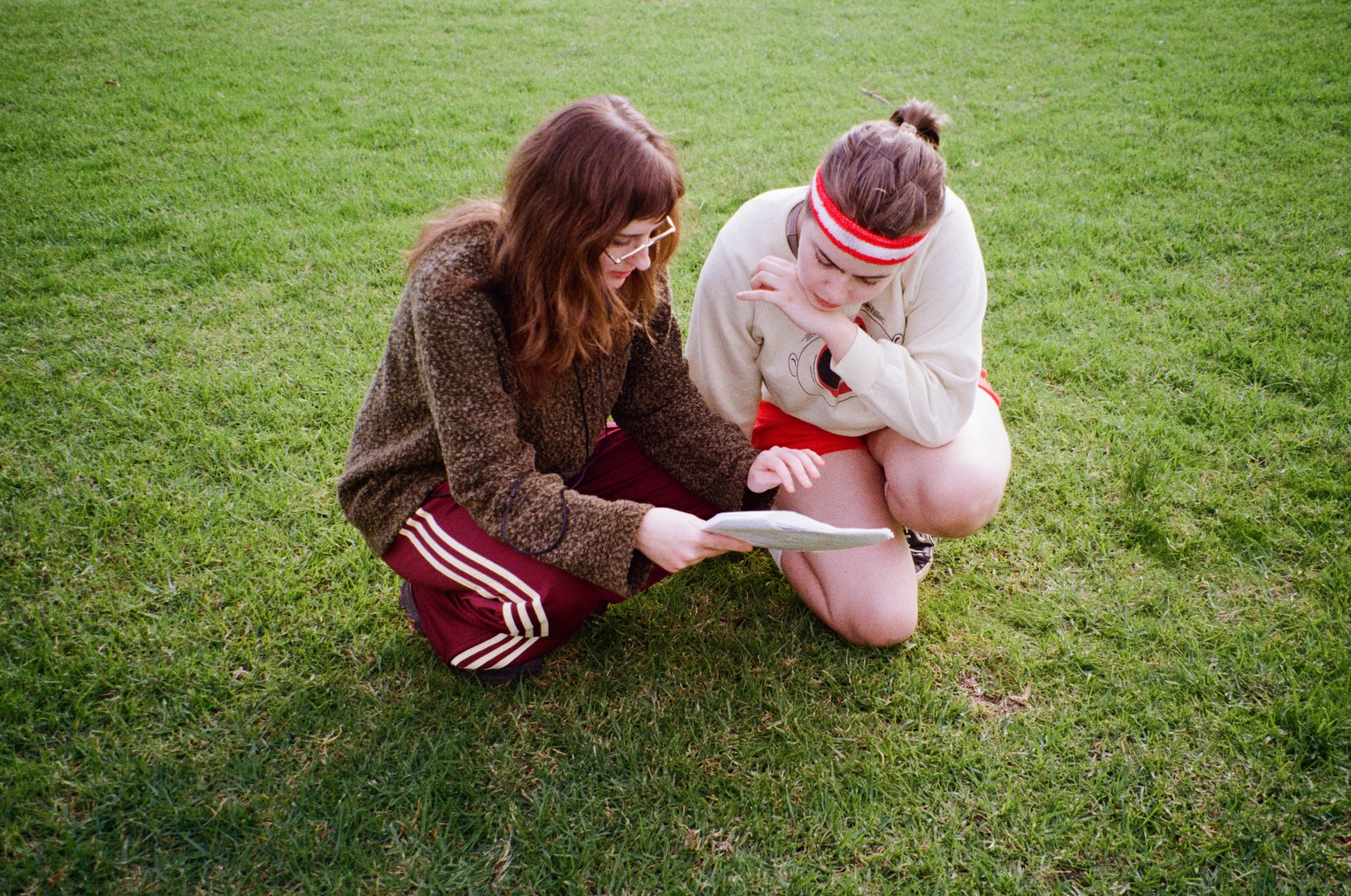
I sit cross-legged at the end of a white bed with green sheets. Across from me, Milla Rovere is similarly in green. Small mysteries litter her room: a quilted wall hanging, paper cranes descending from the arc of her window, a wall of lonely sticky notes. I’m being coy. I’ve seen this room many times before. It’s just up the hallway from my own room. But now, I look closer and with new curiosity. Milla is a good friend of mine, but today I am looking at this room and at her through fresh eyes. Here, she is a director.
Thank you for having me in your room.
Thank you for being in my room.
You’ve been making films since you were 17, 18?
Probably since I was 10.
How has your filmmaking process evolved as you’ve grown up?
I think if anything it’s become more community based. It began with me making Riverdale edits alone on the family computer and making short films with my mum during lockdown.
What’s fascinating is that you essentially began [in film] making edits.
I think that editing was the most accessible thing for me at the time. I didn’t have a lot of friends in high school—mine were basketball kids—so editing was the easiest thing for me to do, and it’s what fulfilled that creative outlet. I also didn’t have to put myself out there; I was making collages of other people’s work.
It began with me making Riverdale edits alone on the family computer and making short films with my mum during lockdown.
The Sag Wagon finished shooting at the end of June. How did you know it was the right time to shoot this film?
There’s this great quote from—I can’t remember who it’s from, and I don’t exactly remember what they say—but it’s like, doing nothing is more exhausting than doing something. I’m still in that mind prison of hating myself for not trying. The idea for The Sag Wagon started in 2024. I was writing it mid-2025, but we didn’t start filming it until the start of 2026. I think 2025 was my year to float around and fuck up a bit. I just thought to myself, ‘If you leave it any longer, it becomes a bigger, scarier thing.’ An object in motion stays in motion, and you’ve just gotta throw yourself at things.
It’s hard to resolve that feeling of, ‘Oh, I’ve fucked up’, or, ‘This is bad’. How have you been able to feel better about fucking up?
I’ve been a person that has tussled with ego and has put a lot of work into things with a focus on the result. I’ve learnt that even if the final product is good, I never feel good about it. It will never be enough. I’ve had to work hard at catching myself when I’m falling into that pattern of doing something because I wanna be perceived in a certain way or I wanna get an accolade. That doesn’t relate to just film, that also relates to relationships, work, anything. I think the turning point for me was when I finished my grad film and I expected all these things to happen because of the film—and they didn’t. But also, they didn’t and I was fine. Milla and I met in film school. Both of us had moved from regional Victoria, bright-eyed and bushy-tailed, hoping to be the chosen few. That, of course, did not happen. Near the end of our third year at the Victorian College of the Arts, our lecturers confessed that the Australian film scene was, in a word, bleak. Funding is few and far between. Jobs are scarce, new productions are scarce, everything is scarce scarce scarce. That terrified me. But now, as I see incredible people like Milla making things, actually making things, I realise that fear is a useless currency.
At the end of June and fresh out of film school, with a portion of scraped-together savings and the help of an exhausted, endlessly talented albeit unpaid crew, Milla directed her first short film, The Sag Wagon.