
TOO LITTLE LIVES: POCKET STORIES BY HUGH CORCORAN
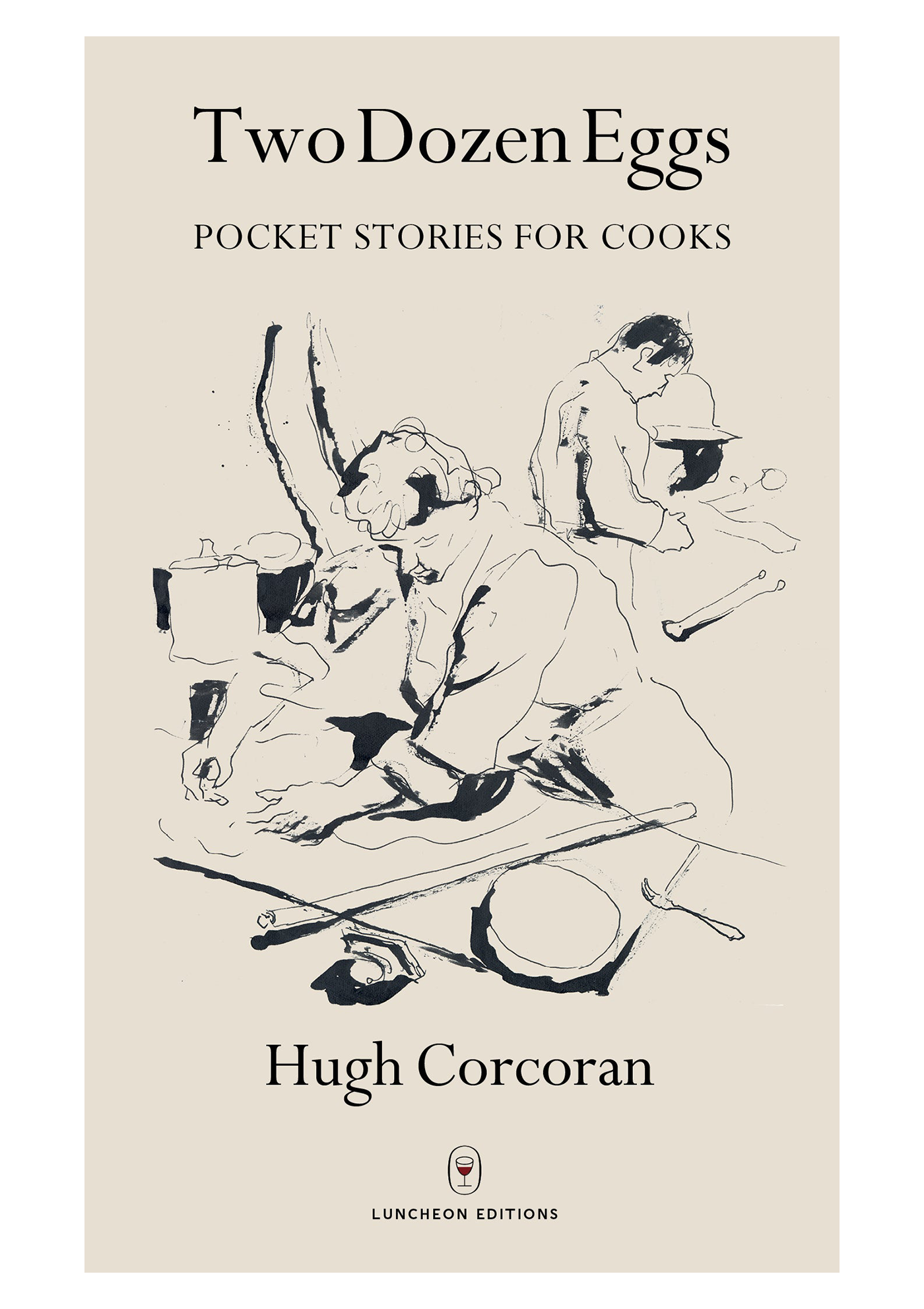
Cover of Two Dozen Eggs: Pocket Stories for Cooks
By Rimini FitzGerald
Hugh Corcoran’s Two Dozen Eggs: Pocket Stories for Cooks is a short story collection and recipe book that seeks to capture the quiet moments that make up our everyday.
Belfast‑born Hugh Corcoran was an enigmatic fixture of the Parisian hospitality scene before establishing The Yellow Bittern in London. He opened the restaurant with his partner, Lady Frances Armstrong‑Jones (publisher of Luncheon Magazine and daughter of the Earl of Snowdon) and art curator Oisín Davies. Since opening in 2023, the restaurant has gathered a loyal literary following and steady litany of controversies. Depending on who you ask, The Yellow Bittern is either elitist working-class cosplay or an idiosyncratic return to intimate dining desperately needed in the homogenisation of modern hospitality. Holding only eighteen covers, the restaurant serves simple food alongside a wine list from Corcoran’s memory. You must pay in cash and reservations can be made over the phone or via postcard. A self-proclaimed ‘Marxist restaurant’, a portrait of Lenin hangs on the wall.
Corcoran intermittently redownloads and deletes Instagram to complain or boast of the Bittern’s diners and contemporary hospitality. It’s easy to sympathise with his contempt for the small-plate economy. Less convincing is his claim that ‘any member of the working class should be able to afford’ the Bittern—the restaurant is only open for weekday lunch sittings and costs approximately £100 pounds (almost $200 AUD). The contradiction has provided the English media with a perfect tableau: a royal connection, Marxism, expensive lunch and a romanticised ideal of the working class.
It is perhaps no surprise then, that Corcoran’s collection of short stories and recipes Two Dozen Eggs: Pocket Stories for Cooks sits in the same uneasy terrain. The stories—or more accurately, vignettes—are each accompanied by a loose recipe: no measurements and a stripped back methodology.
They are quiet, humble, portraits of hard-worked and sleepy days, pictures of a working-class mundanity. A line cook prepares dinner after a long day at work; a lonely man joins a family for Sunday lunches; a grandmother cooks for her grandchildren; others find solace drinking at the pub. After meals ‘they [smoke] a cigarette in silence like lovers just after a fit of desire.’ The stories capture the everyday moments that make up our lives.
Food writing is notoriously difficult; it walks the tightrope of superfluity or boredom. We are inundated with recipes, celebrity chef memoirs, and restaurant recommendations, yet most of this writing lacks the sentimentality required to become memorable. Formally, Corcoran’s approach in Two Dozen Eggs is interesting. He weaves literature and recipes together in a natural way, recognising that most memorable meals are only partially about the food itself. Instead, they have much more to do with the circumstances: where we were, who we were with. A grandmother’s roast, a lunch at the back of a restaurant halfway across the world, a late night takeaway on the way home—these are recipes that slip away without context. Fiction and recipes both try to capture an instance that will never be experienced the same again. They try to leave behind enough to offer a window to return to that initial memory.
Some of Corcoran’s stories are better at this than others. In one vignette, a Parisian grandmother desires only to eat ‘soft-boiled egg from a good hen’ for her birthday. There is something precious, I was reminded, about eating a singular soft-boiled egg when you’re in the mood. Elsewhere, in the Catalan province of Girona, a group of men dressed in ‘simple dark suits of cotton’ spend their afternoons preparing escargots—so steadily that I was almost compelled to search the garden. In another story, the intimacy of a couple in silence preparing dinner for the new year, struck me as casually romantic.
The characters in these stories are often lonely. There is a melancholy beneath their cooking that keeps the reader at a distance. The prose, narratives and characters are simple and stripped back. However, this minimalism and restraint mean many of the stories have nothing to hold them in place. They are quiet to the point of forgettability, and their prose lacks the precision or intimacy for the pleasures of triviality and its insights to emerge.
In the acknowledgements, Corcoran writes that these stories are based on ‘vague memories’ of people he has met. This is exactly how Two Dozen Eggs reads, sketches of characters that feel like memories: slightly blurred and difficult to covey to others, but clearly significant to him. We get small windows into these characters’ lives, but Corcoran doesn’t sit long enough with the characters or the prose to paint a vivid picture. They remain distant and removed. These stories pass you by like somebody else’s memory. The characters arrive, perform their small ritual and disappear without reflection.
The ordinary becomes meaningful only when we pay attention to it. And despite glancing in the right direction, Two Dozen Eggs ultimately does not look closely enough.