
A SHORT HISTORY OF HOSPITALITY
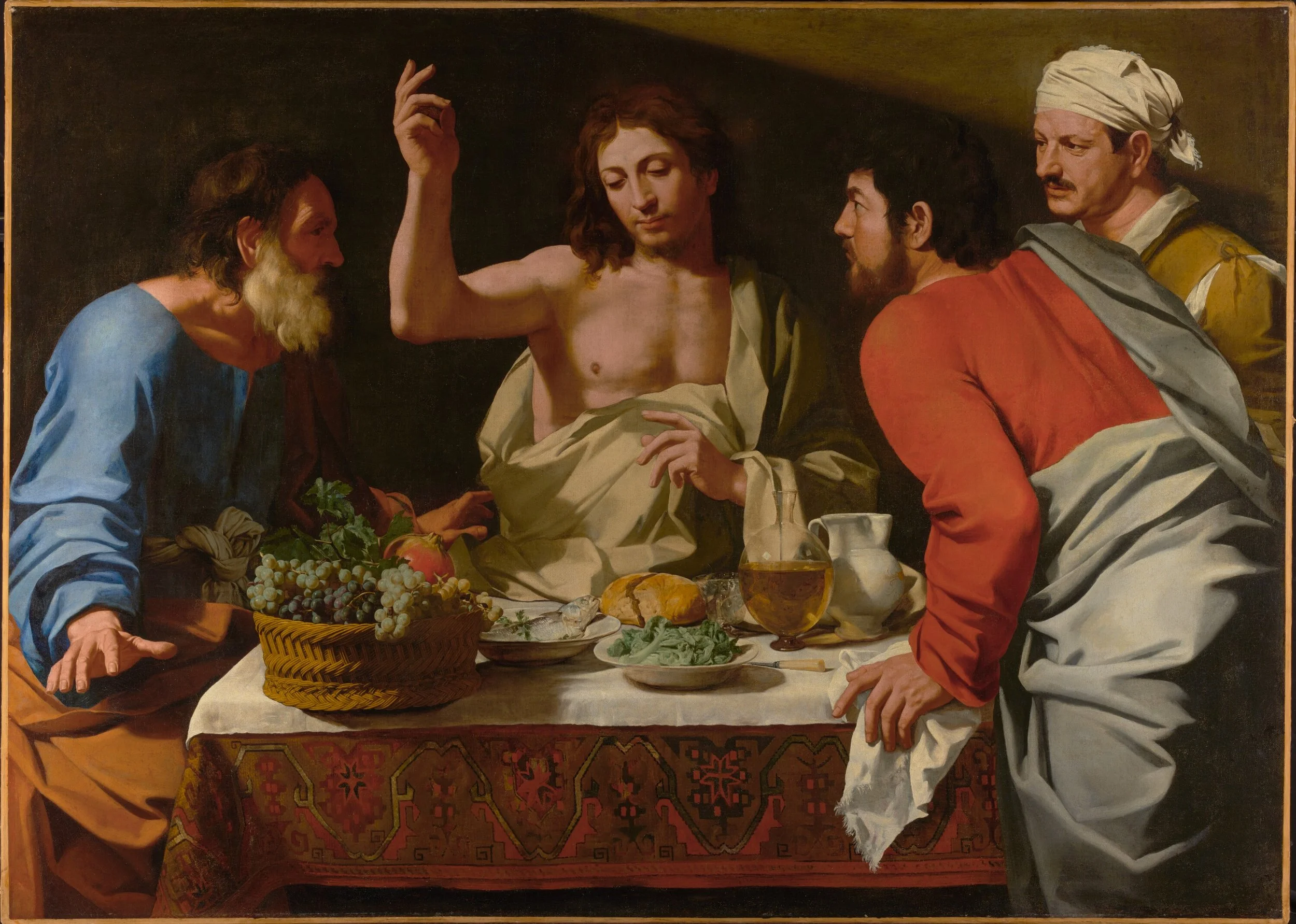
The Supper at Emmaus (1615-1625) - Bartolomeo Cavarozzi (1587-1625)
By Caitlin Wessner
When visiting a restaurant, cafe or bar, we expect those working there to be friendly and welcoming towards their customers. Additionally, we expect them to serve us somewhat speedily. How have we come to expect these (oftentimes) strangers to pander to our whims? The answer can be found by looking back through our history.
Throughout the course of human history, the treatment of guests has been of great importance. Whether that guest was invited or just passing through, being a good host has always been a crucial part of society.
Homer used hospitality in his famous epic, The Odyssey, as a reoccurring theme. The medieval world had a similar expectation of hospitality, though the details of what this looked like had evolved. Saint Benedict wrote in his Rule of Saint Benedict instructions on how guests should be treated by the monks and other residents of monasteries that littered medieval Europe.
The central tenant of hospitality in ancient Greece was xenia, the relationship between the guest and the host. Because ancient Greece was made up of several smaller city-states, xenia was used for diplomacy so that city states could become allies with one another.
The ancient Greeks believed that the gods could and would visit them disguised as humans. If those who were visited did not treat the gods well, there could be dire consequences. Such was the case of Tantalus, who fed the gods his own son and was sent to the realm of Hades for punishment.
There were several rules of xenia. A host was to provide food for a guest before questioning them about their purpose or name. A guest was allowed to stay for as long as they needed and was to be assisted on their way when they left. Often, a gift was to be given to show lasting friendship. A guest was to be courteous in return, and was not to become a burden to their host.
The Odyssey contains the most famous examples of xenia. There are several throughout the work, including examples of xenia being broken. Perhaps most famous is the Polyphemus incident:
Odysseus and his men are in the land of the cyclopes. Investigating the land, Odysseus and twelve of his men enter the cave of Polyphemus, who is out herding his flock. The men want to take some provisions and leave, but Odysseus wishes to test the hospitality of the cave’s owner.
They settle in and are eating some of the food in the cave’s stores when Polyphemus returns. He questions them, demanding to know if they are pirates. Odysseus tells them who they are and says: ‘But we, for our part, come as suppliant to your knees, hoping for hospitality, and the kindness that is due to strangers. […] Zeus protects visitors and suppliants, Zeus the god of guests, who follows the steps of sacred travellers.’
Polyphemus scoffs at this, and when Odysseus tells him that they are shipwrecked (a lie), he proceeds to eat several of the men. Odysseus and his men eventually blind the cyclops and escape.
We can see how Polyphemus broke the laws of xenia, questioning his ‘guests’ and eating them – not what I’d call hospitable. Of course, theoretically Odysseus had broken xenia first when he and his men ate the cheese, but Polyphemus is presented as the bad host. This incident, among others from the work, tells us how entrenched in society the expectation of hospitality was for the ancient Greeks.
Moving forward a few centuries, we come to the Middle Ages. Here, we see a similar attitude to hospitality, though the tenants of hospitality came from a Christian world view. Ideas of hospitality were taken from the Bible.
Despite the difficulties of travel in the Middle Ages, there was a lot of traffic, from pilgrims to crusaders. Travellers needed somewhere to stay and to eat. At some point in England innkeeping became a public duty, and innkeepers had to accept anyone coming through, within reason. It was especially necessary to be hospitable in smaller communities, as news from the outside world came via word-of-mouth.
One of the main places travellers would stay in was a monastery. There were quarters set aside for those who needed to use them. Chapter fifty-three of the Rule of Saint Benedict states, ‘Let all the guests at their arrival be received as Christ, for he himself will one day say: “I was a guest, and you received me” (Matt 25:35). So let fitting honour be shown to all, especially to the household of faith and to travellers.’
Guests were to be greeted warmly and prayed with before being instructed in Divine Law. After this, their hands and feet were to be washed by the brothers, reflecting perhaps the washing of the disciples’ feet at the Last Supper. An abbot, the head of the monastery, was allowed to break his fast on account of a guest, except during important fast days, like Lent. Despite needing to be polite and receptive to guests, the brothers were not supposed to speak to guests unless addressed first .
The requirement to host guests did not excuse guests from being considerate in return. Guests were only supposed to stay for two days and two nights at the monasteries, though not everyone followed this. Nunneries, under similar rules, had ‘gentlewomen’ who would stay for a year or more. The problem became bad enough that, in England at least, Edward I forbade the staying or eating in religious institutes because of this abuse of guest rights.
Monastic hospitality remains alive in contemporary times. Across Europe, you can stay in a monastery to this day.
In 21st century Melbourne, hospitality has changed a lot, yet holds many of the original seeds. We still expect to be treated respectfully and warmly when visiting a restaurant or café. However, these expectations are now rooted in values of commercialisation. We want good service because we believe we’re paying for it.
Guests are still expected to behave in an appropriate manner, not overstaying their welcome or being harsh towards workers. Now, though, we have social media to vent about nasty interactions or bad customer service.
One restaurant that comes to mind when I think of hospitality in Melbourne is Papa Gino’s Italian restaurant on Lygon Street. As a kid, we didn’t get to eat out a lot; with five kids my parents just found it impractical. I fondly remember visiting this restaurant where my dad decided to treat us one day. It was quite near his work, and he would often eat lunch there; that day he ordered ‘the usual’—a Papa Gino’s special with no anchovies.
We as a family have gone back a few times in recent years and not much seems to have changed. The atmosphere remains friendly and warm; the ambience is wonderful. My family has always received wonderful service there, and the food is amazing to boot!
While the centuries may have moved on and attitudes may have changed, one thing has remained the same, the host-guest relationship. We can see this through the similarities and differences of ancient Greece’s xenia and the Middle Ages monastic hospitality. Despite the modern world reducing the host-guest relationship to a commercial venture, we still hold many of the same values and expectations. Papa Gino’s is just one example of many; you just have to look.