
RECONNECTING THROUGH SPONGE CAKE
By Kate Purchase
Each year on their birthdays Kate’s family—like a lot of families—have cake.
Red velvet, chocolate, or my favourite, a simple sponge cake. It doesn’t matter; they are all delicious. And when presenting them to the birthday person we don’t just use one of the everyday plates but, instead, the glass cake stand that belonged to my mum’s nan, Doreen. Usually, this delicate stand sits tucked away in a cabinet, but for a few times a year it gets to come out and fulfil its purpose once more.
It was after my birthday this year that I started to think about Doreen more and the minimal things that I knew about this interesting woman. So, I started to explore the cabinet that held the items she had passed down to my mum. First was the trophy she had been awarded in 1931 for her record breaking bike ride from Melbourne to Adelaide and back at 20 years old (the first person ever to do so, and a record that still stands today). Then I came across her 1965 first place trophy from the Royal Melbourne Show for her wedding cake. And finally, an old worn prayer book that belonged to her mother along with a yellow paged recipe book with crisp handwriting inside detailing delicious desserts.
Reading over the recipes mixed in with random scribbles drawn by myself as a child, I recognised the similarities with Doreen’s own scribbles in the prayer book. Little Doreen drawing away in her mum’s prayer book, and then some 80 or so years later, her great-granddaughter creating her own scribbles on another precious book. These marks, left unchanged, passed down like secret heirlooms that connect me and her.
Eventually, in the spirit of reconnecting with my scribbling buddy, I decided to recreate some of Nan Doreen’s recipes. I started with her famous sponge cake.
My first attempt ran into some issues. It started out alright: the ingredients were prepared, the bowls and trays were out waiting and I made plenty of time to bake. I was ready to go. What I didn’t consider was the equipment needed to achieve that light fluffy texture of a delicious sponge.
As this recipe is from around the 1950s, I (wrongly) assumed that my nan did not have an electric mixer. One text to my mum proved otherwise. When combining the egg whites in with the sugar I decided to use muscle power. When I eventually gave up and got out the electric hand beater, I had not achieved the stiff peaks that I needed. This resulted in me frantically adding more sugar and continuing to beat the batter in a desperate attempt to correct my mistake. I can only imagine that somewhere out there Doreen was yelling at me to stop and probably just to start again. But unfortunately, I cannot commune with the dead and so I carried on.
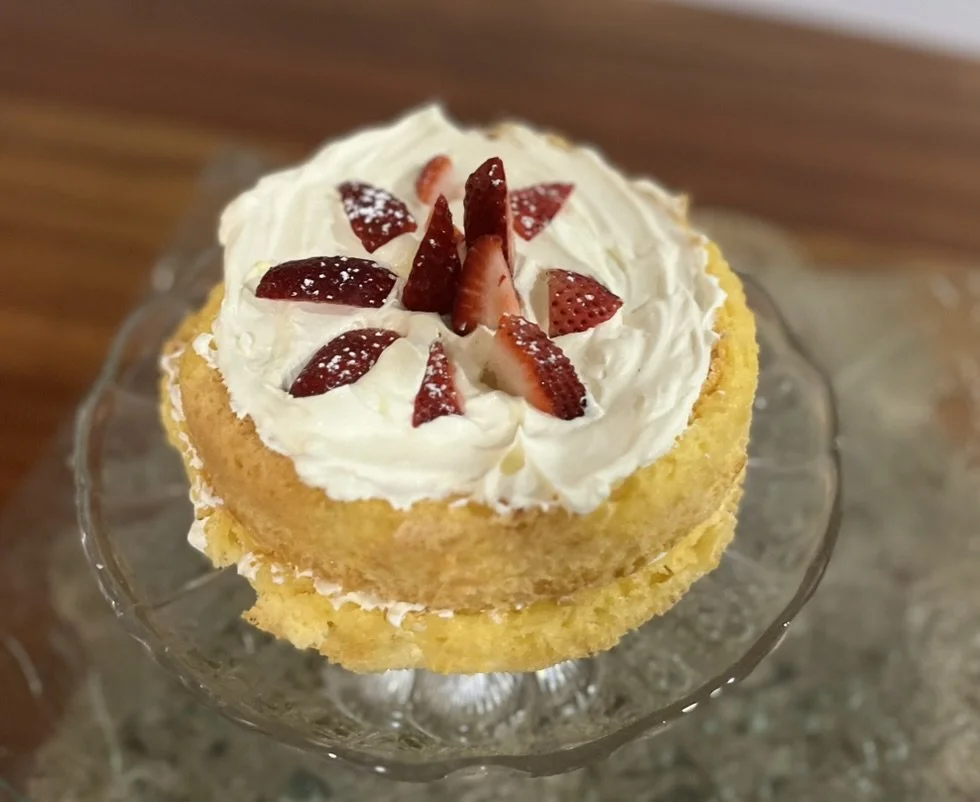
Then, while sifting the dry ingredients three times as specified and folding them into the wet mix, I began to realise the problem. The volume of the batter was deflating due to the overbeating and extra sugar. Yet, in a desperate attempt to ignore my mistake, I happily continued on pouring the batter into two baking trays. Then, I proceeded to wait, blissfully unaware of the erosion occurring within the oven. When the timer finally went off and I extracted the tins from their temporary home, I was met with the final product of two sunken cakes, lacking the necessary fluffy rise needed to hold their shape. On a positive note, they were nicely baked, so I will take that as a win! And thankfully whipped cream and jam can do wonders to make up for a cake’s imperfections caused by its ignorant creator.
Despite the issues and not-so-perfect result, I still felt proud to have created something that Nan would have made hundreds of times, probably having the same issues I had on her first attempt as well. So, as I served up Nan’s sponge on her own glass cake stand in front of my family, I hoped that she was happy to see her recipes being used and her accomplishments acknowledged. And it still tasted delicious, which is the most important thing!
I promise next time I will use the electric mixer. However, if it fails again, I might have to consider cycling from Melbourne to Adelaide and back. Here’s to hoping the next sponge holds up.