
A CLUE, A MORSEL: NIGEL SLATER’S MEMOIR TOAST
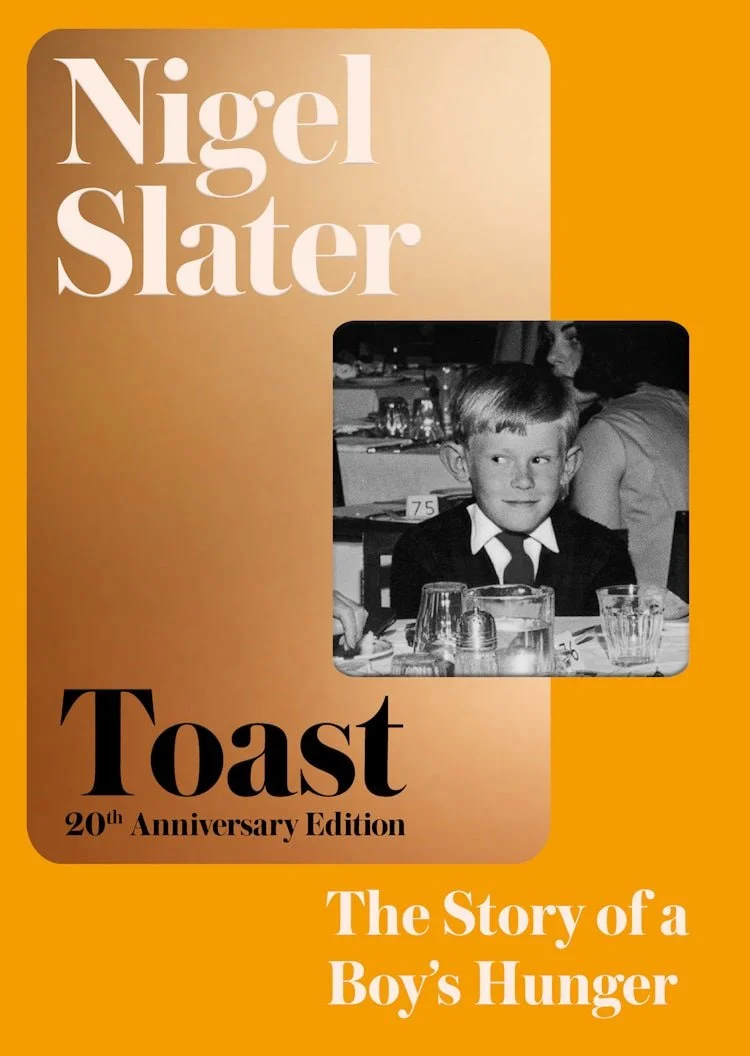
20th anniversary edition cover of Nigel Slater’s memoir Toast: the story of a boy’s hunger. A photo of a boy in a dinner suit is placed in the centre. The title of the book is written at the bottom.
By Bridget Mahy
Unhappy families, coded domestic rituals and James Wood’s concept of total recall are found in British celebrity chef Nigel Slater’s memoir.
In Toast, sweets have political valences. Only girls are allowed to eat Love Hearts and sherbert fountains. Firmly in boy-territory are Gobstoppers, Milky Bars and Rolos. How resolute then is the schoolboy who ignores these rules, dipping liquorice into a sherbert pouch to himself and seeking out Love Hearts to share. This is a boy who rearranged the heart-shaped lollies so that the desired message would be drawn by the right person—messages such as ‘You’re Cute’ or ‘Kiss Me’ or ‘Big Boy’. He was also incidentally the last to be picked for sport.
Throughout Toast, foods are given meanings to be decoded. It is largely distant, authoritative adults who give foods this symbolic power. The boy Nigel is a careful cataloguer in his household. We are granted a picture of a lonely childhood, with strict, status-conscious middle class parents disallowing any mention of ‘Babycham, sandwich spread, tomato ketchup, bubble-gum, HP Sauce and Branston Pickle.’ Nigel’s mother passes away when he is nine years old and he is left with his father and the expedient substitute: Joan. Without a mother to tuck him into bed, two marshmallows are left on his bedside each night. This is how marshmallows come to a symbolise a goodnight kiss—an affection too hard to win from his father.
Eggs, on the other hand, are character-building, manly. Slater writes, ‘to turn a nine-year-old nancy boy (his phrase) into a strapping son-to-be-proud-of, you simply added an egg.’ His father forces Nigel to eat them, once even threatening to hit him if he didn’t. On another occasion, he attempts to push a fork with a piece of rubbery egg stabbed on the end into Nigel’s mouth. A wasted effort. Nigel runs upstairs to vomit in the bathroom.
Joan competes with Nigel for his father’s affection. On the days Nigel has home-economics class, she is sure to cook an elaborate meal, Nigel’s: ‘four cold rissoles wrapped in tinfoil seemed a somehow pathetic offering now that Joan had taken up making mandarin orange and maraschino cherry pavlova’. Most keenly representing Joan’s brittle pride is Lemon Meringue Pie. This recipe is guarded so closely that Nigel is forbidden from the kitchen while she makes it. He has to wait until she is distracted by the TV before surreptitiously counting the eggshells and lemon skins left in the bin. Unable to ask, he gleans the recipe in parts for himself.
These anecdotes throw into relief a childhood eked out of domestic codes. It feels as though an emotional space is hollowed in the book by what is not said. The gorgeous bloat of guesswork, gesture and observation is there to paper over this vacancy.
With all of the communicative power given to food, it is no wonder that this memoir takes on such a hyper-observant style. Each shiny detail is dutifully catalogued by the author, indexed and filed. I’m reminded of the phrase ‘total recall’ used by James Wood to describe Knausgaard’s autofiction novel My Struggle. He argues that this book is crammed with impossible detail. By dint of this detail, the book is fictional and, rather than offering fact, amounts to a narrative style. Toast, with its beady adolescent narrator, is similarly allied in employing these ‘recall' techniques. Listing is one. Nigel writes of Christmas:
‘ ... the windows would light up with clementines in coloured foil, biscuits in tins with stagecoaches on the lids, fresh pineapples, whole peaches in tins, trifle sponges and packets of silver balls and sugared almonds.’
In addition to listing, there are entries in Toast with details that strikes one as hard to remember. Nigel sees out of a car window a ‘young girl in jeans and a striped butcher's apron sprinting back from the walled garden with a handful of dill fronds.’ He remembers that there were ‘white nets at the windows’, in the dining hall on a distant holiday, ‘tied back with coloured ribbons.’ While I can’t confirm the level of invention in this book (and likely all memoirs have at least some) I get the sense that Slater would prefer to err on the side of fact than style. In employing these Knausgaardian techniques, details serve the voice of the cataloguing narrator, eager to notice and create meaning.
Near the end of the book Nigel gets his first job in a local restaurant and explores his sexuality, albeit clandestinely. At this stage of the narrative, the associations of food become uplifting. In childhood, he pieced together codes as a supplement papering over a lack. In adulthood, able to cook for others, there is joy found in the communicative quality of a dish. A specially enjoyed secret. Where two marshmallows represented a meagre bid for affection, the pommes dauphinoise at Thornbury castle was ‘pure sex’. Perhaps the encrypted quality of food in Toast, lead Slater to say to The Guardian:
‘Food is, for me, for everybody, a very sexual thing and I think I realised that quite early on. I still cannot exaggerate how just putting a meal in front of somebody is really more of a buzz for me than anything … ’
